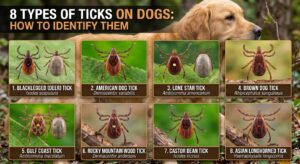
8 Most Common Types of Ticks.
Eight important types to recognize are the lone star tick, blacklegged (deer) tick, brown dog tick, American dog tick, Gulf Coast tick, Rocky Mountain wood tick, western blacklegged tick, and Asian longhorned tick. Each has distinguishing features, but size and color can change as a tick feeds.
The most important rule: remove an attached tick promptly and safely rather than waiting to identify it. A photograph or preserved specimen may help your veterinarian identify the species, but appearance alone cannot establish whether a tick is infected.
This guide focuses on dogs and tick species relevant to the United States. Tick distributions change over time, and a species may occur outside its best-known range. Consult local veterinary and public-health guidance when assessing regional risk.
How to Identify a Tick on Your Dog
Ticks are arachnids, related to spiders and mites, rather than insects. Adult ticks and nymphs have eight legs; tick larvae have six. They attach to the skin and feed on blood. A small tick may look like a dark speck, while a feeding female can become rounded and much larger.
Look for these identifying features
- Color and markings: Some species have a plain brown body, while others have pale or ornate markings on the hard shield behind the head.
- Leg color: Dark legs contrasting with a reddish body can help distinguish certain blacklegged ticks.
- Body shape: An unfed tick is usually flatter. A blood-fed tick may be swollen, grayish, or balloon-like.
- Size and life stage: Larvae, nymphs, and adults differ in size. Size alone is not enough to identify a species.
- Attachment location: Ticks may be found around the ears, head, neck, shoulders, between the toes, under the legs, around the groin, and beneath the tail.
Use these features to narrow down the possibilities, not to make a definitive diagnosis. Different species can look similar, and feeding can distort their normal appearance. The Merck Veterinary Manual provides further guidance in its overview of ticks of dogs.
8 Types of Ticks on Dogs
1. Lone Star Tick (Amblyomma americanum)
How to identify it: An adult female has a conspicuous pale or white spot near the center of her back, which gives this tick its common name. The body is generally reddish-brown, and the mouthparts are relatively long. Adult males have different markings, so the single white spot is most useful when identifying an adult female. If you decide to remove this tick by yourself, you need the Homesake Tick Remover Tool for Dogs.
Where it is found: The lone star tick is widely distributed across the eastern, southeastern, and parts of the midwestern United States. Its range has changed over time, so local surveillance is important.
Why it matters: Lone star ticks can transmit pathogens associated with ehrlichiosis and tularemia in people. They are also associated with other human health concerns, including alpha-gal syndrome. Disease associations in humans should not automatically be interpreted as confirmed risks of the same magnitude in dogs; veterinary assessment should reflect the dog’s symptoms and exposure.
Where to check your dog: Examine the head, ears, neck, armpits, groin, and other areas where the coat is thin or the skin folds.
Identification tip: A white spot on an adult female is a useful clue, but the absence of a spot does not rule out this species. Nymphs and males may look different.
See the CDC’s tick distribution and identification information.
2. Blacklegged or Deer Tick (Ixodes scapularis)
How to identify it: This tick is often small. Adults typically have dark legs and a dark shield, with a reddish-orange area on the female’s body behind the shield. The shield does not cover the entire back of an adult female, allowing the abdomen to expand as she feeds. Nymphs are much smaller and harder to spot. A recommended tool for Deer Tick Removal: SiDEKiCK Tick Removal Tool with Integrated Flashlight.
Where it is found: The eastern blacklegged tick is widely distributed in the eastern United States, including parts of the Northeast and Midwest. Local abundance varies substantially.
Why it matters: This species can transmit the bacteria responsible for Lyme disease and can also be associated with anaplasmosis and babesiosis. Not every tick carries a pathogen, and finding a tick does not mean a dog has become infected.
Where to check your dog: Carefully inspect the head, ears, neck, and back. Part the coat with your fingers and feel for small attached bumps, especially after woodland walks.
Identification tip: Deer ticks can be easy to overlook because unfed adults and nymphs are small. Do not assume that a tiny tick is harmless.
Learn more from the CDC’s guide to where ticks live.
3. Brown Dog Tick (Rhipicephalus sanguineus)
How to identify it: Brown dog ticks are generally reddish-brown and lack the striking pale ornamental markings seen on American dog ticks. Their bodies are relatively narrow and elongated. After feeding, a female becomes noticeably larger and more rounded.
Where it is found: This species occurs worldwide and can be found throughout the United States. Unlike many ticks encountered in vegetation, brown dog ticks can establish infestations inside homes, kennels, and other buildings where dogs live.
Why it matters: Brown dog ticks are particularly important because their entire life cycle can occur around dogs and in the indoor environment. They are a recognized vector of Rocky Mountain spotted fever in the southwestern United States and along the U.S.–Mexico border. They are also associated with several canine tick-borne infections.
Where to check your dog: Examine the head, neck, ears, legs, and feet. Also check the dog’s bedding, kennel, and cracks or crevices if ticks keep reappearing indoors.
Identification tip: A plain reddish-brown tick found on a dog is not automatically a brown dog tick. Other species can have similar coloring, so expert identification may be necessary.
Important: Repeated sightings indoors may indicate an established infestation rather than a single tick brought home from a walk. Contact your veterinarian and, when appropriate, a licensed pest-management professional.
CAPC explains the challenges of controlling brown dog tick infestations.
4. American Dog Tick (Dermacentor variabilis)
How to identify it: Adults are typically brown with contrasting cream, silver-gray, or whitish markings on the hard shield. The pattern is often more ornate than the relatively plain shield of a brown dog tick. Adult females have a smaller patterned shield near the front of the back, while males have a patterned shield covering most of the dorsal surface.
Where it is found: The American dog tick is widespread east of the Rocky Mountains, with populations also recorded in some western areas. Related tick species occur west of the Rockies, so identification and distribution should be interpreted carefully.
Why it matters: American dog ticks can transmit the pathogens responsible for Rocky Mountain spotted fever and tularemia. Heavy infestations may also cause skin damage, and serious infestations can contribute to anemia.
Where to check your dog: Pay particular attention to the head, neck, shoulders, and back after walks in grassy fields, brush, and along trail edges.
Identification tip: Look for pale ornamental markings on the shield. However, a tick’s size is not a dependable way to distinguish an American dog tick from a deer tick because life stage and feeding status affect size.
Reference: CDC American dog tick surveillance.
5. Gulf Coast Tick (Amblyomma maculatum)
How to identify it: The Gulf Coast tick has relatively long mouthparts. Adult females often have pale or silvery markings on the shield, while males may show more extensive mottling. Its appearance can overlap with that of other patterned ticks, making close inspection important.
Where it is found: It is most strongly associated with the southeastern United States, although populations have also been documented in localized areas elsewhere, including parts of the Midwest, Northeast, and Southwest.
Why it matters: The Gulf Coast tick is associated with Rickettsia parkeri rickettsiosis in humans. In dogs, this species is also of veterinary concern and may be associated with tick-borne illness and skin lesions. A veterinarian can assess the relevance of a suspected bite based on the dog’s location and clinical signs.
Where to check your dog: Inspect the ears, head, neck, and other exposed areas after time in grassy or brushy habitats.
Identification tip: Do not rely on a single pale marking. Several tick species have contrasting patterns, and identification from a photograph may be uncertain.
For current regional information, consult the CDC’s tick distribution guide.
6. Rocky Mountain Wood Tick (Dermacentor andersoni)
How to identify it: Adults generally have a brown body with pale, ornate markings on the shield. Their appearance resembles that of other ticks in the genus Dermacentor, including the American dog tick. A photograph alone may not be enough to tell them apart.
Where it is found: This tick is associated with the Rocky Mountain region of the United States and southwestern Canada, particularly suitable habitats at higher elevations.
Why it matters: Rocky Mountain wood ticks are associated with pathogens that cause Rocky Mountain spotted fever, Colorado tick fever, and tularemia in humans. Certain tick species can also produce toxins that affect animals. If a dog develops weakness, abnormal walking, or progressive difficulty moving after tick exposure, seek urgent veterinary care.
Where to check your dog: Thoroughly examine the head, neck, ears, and body after outdoor activity in brushy or grassy mountain habitats.
Identification tip: Ornate markings suggest a Dermacentor tick but do not, by themselves, establish the exact species.
Reference: CDC information on tick habitats and distributions.
7. Western Blacklegged Tick (Ixodes pacificus)
How to identify it: This species closely resembles the eastern blacklegged tick. Adults are small, with dark legs and a dark shield; females often have a reddish-orange abdomen behind the shield. Accurate identification may require expert examination.
Where it is found: The western blacklegged tick occurs along the Pacific coast, particularly in California and other suitable areas of the western United States. Distribution varies locally.
Why it matters: It can transmit the bacteria responsible for Lyme disease and is associated with anaplasmosis and other tick-borne infections. The presence of this tick does not prove that an individual tick carries a pathogen.
Where to check your dog: Inspect the ears, head, neck, and areas where the coat is thin after hikes or walks in woodland, chaparral, and other tick-supporting habitats.
Identification tip: The western and eastern blacklegged ticks look very similar. Geographic location can help narrow the possibilities, but it cannot confirm a species on its own.
See the CDC’s overview of western blacklegged ticks.
8. Asian Longhorned Tick (Haemaphysalis longicornis)
How to identify it: Asian longhorned ticks are generally small and brown, with no conspicuous white star like that of the female lone star tick. Their appearance may be difficult to distinguish from other small brown ticks without magnification or specialist identification.
Where it is found: First detected in the United States in 2017, this species has since been reported in multiple eastern and midwestern states. Its distribution continues to be monitored, and the current list of affected areas may change.
Why it matters: Asian longhorned ticks can feed on dogs, livestock, wildlife, and other hosts. Females can reproduce without mating, and very large numbers of ticks may sometimes occur together on an animal. Research into the public-health and veterinary significance of established U.S. populations continues.
Where to check your dog: Inspect the entire body, especially if you notice numerous tiny ticks clustered in one area or if your dog has recently visited an affected region.
Identification tip: A cluster of many small ticks deserves prompt attention. Photograph the infestation and contact your veterinarian rather than trying to identify or treat a large infestation solely at home.
For current distribution information, consult the CDC’s tick guide and the USDA Animal and Plant Health Inspection Service.
Quick Comparison: Types of Ticks on Dogs
| Tick type | Typical identifying clue | Broad U.S. distribution | Important concern |
|---|---|---|---|
| Lone star | White spot on adult female | East, South, parts of Midwest | Several tick-borne pathogens; human alpha-gal association |
| Blacklegged/deer | Small body, dark legs, dark shield | Eastern U.S., including Midwest | Lyme disease and other infections |
| Brown dog | Plain reddish-brown body | Nationwide; can live indoors | Indoor infestations and canine disease |
| American dog | Ornate pale markings on shield | Mostly east of Rockies | Rocky Mountain spotted fever, tularemia |
| Gulf Coast | Long mouthparts; pale shield markings | Primarily Southeast, with other localized areas | Spotted-fever rickettsiosis; veterinary concerns |
| Rocky Mountain wood | Ornate shield resembling other Dermacentor ticks | Rocky Mountain region | Tick-borne infections; possible toxin effects |
| Western blacklegged | Small, dark-legged tick resembling eastern species | Pacific coast | Lyme disease and anaplasmosis |
| Asian longhorned | Small, brown tick; may occur in clusters | Reported in multiple eastern and midwestern states | Large infestations; ongoing disease research |
This table is a screening aid, not a definitive identification key. Distribution, appearance, and disease associations can vary, and not every tick of a given species carries an infectious agent.
How to Remove a Tick From Your Dog Safely
If you find an attached tick, remove it as soon as possible. Prompt removal reduces the time the tick has to feed and potentially transmit pathogens or toxins.
- Prepare fine-tipped tweezers. If possible, wear disposable gloves and keep your dog still. Ask another adult to help restrain the dog gently if necessary.
- Grip the tick close to the skin. Hold it near the point where its mouthparts enter the skin, rather than squeezing the swollen body.
- Pull steadily upward. Use slow, even pressure. Avoid twisting, jerking, or crushing the tick.
- Clean the area. Wash the bite site and your hands with soap and water or an appropriate skin antiseptic.
- Keep a record. Take a clear photograph of the tick and note the date and location where your dog was exposed. If practical, preserve the tick in a sealed container according to your veterinarian’s instructions.
- Check the rest of the dog. More than one tick may be attached. Examine the entire body and inspect other pets in the household.
Do not burn a tick, apply nail polish, use petroleum jelly to make it detach, or crush it with your fingers. These methods can delay removal or increase exposure to tick material. If the mouthparts remain embedded and cannot be removed easily, do not dig deeply into the skin; ask your veterinarian for advice.
For detailed instructions, see the Merck Veterinary Manual’s tick-removal guidance.
When Should You Call a Veterinarian?
Contact your veterinarian if your dog has a suspected tick bite and develops new symptoms, particularly if the tick was attached for an uncertain length of time or the dog lives in or has visited an area with known tick-borne disease.
Warning signs to watch for
- Unusual tiredness, weakness, or reduced activity.
- Loss of appetite or fever.
- Joint stiffness, limping, or difficulty walking.
- Swelling, persistent redness, discharge, or worsening irritation at the bite site.
- Pale gums, collapse, or marked weakness, particularly after a heavy infestation.
- Unsteady walking, progressive weakness, difficulty swallowing, or breathing problems.
Seek urgent veterinary care for breathing difficulty, collapse, rapidly worsening weakness, or paralysis-like symptoms. Heavy infestations also warrant prompt veterinary assessment because blood loss, skin injury, and other complications can occur.
Do not wait for symptoms to appear before asking for advice if you are concerned about a high-risk exposure. Your veterinarian can determine whether examination, testing, monitoring, or treatment is appropriate. Testing immediately after a bite may not always detect a newly acquired infection, so follow-up may be recommended.
How to Prevent Ticks on Dogs
Use veterinarian-recommended tick prevention
Ask your veterinarian to recommend a tick-control product suitable for your dog’s age, weight, health, lifestyle, and regional risks. Products may include oral medications, topical treatments, or collars. They do not all cover the same tick species or work in the same way, so check the product label and follow the dosing schedule.
CAPC recommends year-round tick control for dogs because tick activity can occur in different seasons and brown dog ticks can persist indoors. Never use a dog-labeled product on a cat unless the product is specifically labeled for that animal; some ingredients used in dog products can be highly toxic to cats.
Check your dog after outdoor activity
Run your hands through your dog’s coat and inspect the skin carefully after walks, hikes, camping, or time in brush and tall grass. Pay particular attention to the ears, under the collar, between the toes, around the armpits, in the groin, and beneath the tail.
Make your yard less inviting to ticks
- Keep grass trimmed and remove accumulated leaf litter and brush piles.
- Limit access to dense vegetation where practical.
- Keep dogs away from areas known to have heavy tick activity.
- Ask a licensed pest-management professional about targeted treatment if a tick infestation becomes established indoors.
Prevention reduces exposure but cannot guarantee that a dog will never carry a tick. Continue checking your pet even when using a preventive product.
Further guidance is available from CAPC’s tick-control recommendations.
Frequently Asked Questions
1. What is the most common type of tick found on dogs?
It depends on the region, habitat, season, and how ticks are sampled. A U.S. study of ticks submitted from dogs and cats identified American dog ticks, blacklegged ticks, lone star ticks, and brown dog ticks among the leading species found on dogs. That study should not be interpreted as a universal ranking for every state or household.
2. How can I tell if a tick on my dog is a deer tick?
Blacklegged ticks are typically small, with dark legs and a dark shield; adult females often have a reddish-orange body behind the shield. However, life stage, feeding status, and similarities between species can make identification difficult. A veterinarian or qualified tick-identification service can help confirm the species.
3. Can I identify a tick by its size?
Size can provide a clue, but it is not reliable on its own. Tick larvae, nymphs, and adults differ in size, and a tick grows substantially as it feeds. Use markings, body features, geographic location, and expert identification rather than size alone.
4. Are all ticks on dogs dangerous?
Not every tick carries a disease-causing organism, and not every bite results in illness. Nevertheless, any attached tick should be removed promptly and safely. Monitor your dog and contact your veterinarian if symptoms develop or you are worried about the exposure.
5. Can ticks live inside a house?
Yes. Brown dog ticks are particularly capable of establishing indoor infestations in homes and kennels. If ticks repeatedly appear on your dog or around its bedding, contact your veterinarian and consider professional pest-control advice.
6. Can a dog get Lyme disease from a tick?
Yes. In the United States, blacklegged ticks can transmit the bacteria that cause Lyme disease. A tick bite does not mean infection has occurred. A veterinarian can assess exposure, symptoms, and whether testing or monitoring is appropriate.
7. Should I save a tick after removing it?
A clear photograph and a record of when and where the tick was found can be useful. If you can safely preserve the specimen, ask your veterinarian how to store it. Tick identification may help assess exposure, but it cannot by itself establish whether a pathogen was transmitted.
8. Do dogs need tick prevention during winter?
Tick activity varies by location and weather, and some ticks can remain active during mild winter periods. Brown dog ticks can also survive indoors. Ask your veterinarian about year-round prevention based on your dog’s circumstances and local risks.
9. What should I do if my dog has dozens of ticks?
Contact a veterinarian promptly rather than relying on home removal alone. Heavy infestations can cause skin damage, anemia, and other serious complications. Your veterinarian can advise on safe removal, treatment, and environmental control.
10. Can I tell whether a tick carries Lyme disease by looking at it?
No. A tick’s appearance cannot tell you whether it carries Lyme disease or another pathogen. Identification, local disease risk, exposure details, and your dog’s clinical condition all matter when deciding what follow-up is needed.
Conclusion
Knowing the differences between the eight tick types described in this guide can help you recognize potential risks and communicate more clearly with your veterinarian. The white spot of an adult female lone star tick, the dark legs of blacklegged ticks, and the pale markings of American dog ticks are useful clues, but none replaces expert identification when the species matters clinically.
If you find a tick, remove it promptly with fine-tipped tweezers, check your dog for additional ticks, and monitor for changes in health. Use veterinarian-recommended prevention and seek professional care for concerning symptoms or heavy infestations.
Educational disclaimer: This article provides general pet-health information and is not a substitute for veterinary diagnosis or treatment. Contact a qualified veterinarian for advice specific to your dog.
More resources for Dog Owners.
- Recommended Tick Sprays for Dogs: 5 Recommended Tick Sprays for Dogs: Advantages, Disadvantages, and How to Choose
- Centers for Disease Control and Prevention (CDC): Where Ticks Live. Species, geographic distribution, and disease information.
- Merck Veterinary Manual: Ticks of Dogs. Tick biology, attachment, health concerns, and general management.
- Merck Veterinary Manual: Tick Removal. Safe tick-removal guidance.
- Companion Animal Parasite Council: Ticks. Veterinary recommendations for tick control and environmental management.
- Show Us Your Ticks: A Survey of Ticks Infesting Dogs and Cats Across the USA. Published research on species identified from submitted pet ticks.
- CDC: American Dog Tick Surveillance. Distribution and surveillance information.
- USDA Animal and Plant Health Inspection Service. Official animal-health resources, including information relevant to emerging tick species.
Recent Content
Choosing the best flea and tick prevention for dogs means finding a product that matches your dog's age, weight, health history, lifestyle, and exposure to parasites. Some treatments come as chewable...
Tick sprays can be a useful part of a dog's parasite-prevention routine. They vary in their active ingredients, how they control ticks, how frequently they must be applied, and the precautions owners...