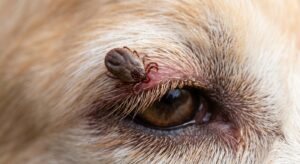
Tick on Dog’s Eyelid: What to Do Safely—and When to See a Veterinarian
Do not squeeze the tick, burn it, cover it with petroleum jelly or nail polish, or try to dig it out. These methods can irritate the skin, injure the delicate eyelid, or make the tick release more fluid into the bite site. The goal is prompt, complete removal without trauma to the eye area. In this guide, I will provide guidance on what to do, how to do safely, and when to see a Veterinarian.
Why a Tick on the Eyelid Needs Extra Care
Ticks can attach anywhere on a dog, but the eyelid is a particularly delicate location. The skin is thin, close to the eye, and prone to swelling. A poorly controlled removal attempt can scratch the cornea, pinch the eyelid, leave mouthparts behind, or cause your dog to jerk suddenly.
Ticks are blood-feeding parasites—not insects—and some can transmit diseases such as Lyme disease, ehrlichiosis, and Rocky Mountain spotted fever while feeding. They can also cause local skin irritation or secondary infection. Removing an attached tick promptly helps reduce the time a tick has to feed and potentially transmit pathogens.
That said, finding one tick does not mean your dog will become ill. Many tick bites cause only a small local reaction. The priority is safe removal, followed by monitoring the bite site and your dog’s overall condition.
First, Confirm It Is Actually a Tick
Before reaching for tweezers, make sure the bump is a tick. A tick that has recently attached often looks like a small, flat, dark-brown or black oval. One that has been feeding for days may look rounded, gray, or swollen.
What a Tick Usually Looks Like
- A small oval or round body attached directly to the skin
- Brown, black, gray, or reddish coloring
- Tiny legs near the front when viewed closely
- No discharge, pimple-like head, or obvious hair growing from it
- A body that may enlarge as it feeds
Common Look-Alikes Near a Dog’s Eye
Not every dark spot near the eyelid is a tick. It could be a skin tag, a blocked gland, an insect bite, a small cyst, a scab, dirt, or a growth. If the object has legs, is firmly attached, and seems to be enlarging, it is more likely to be a tick.
If you are not sure, take a clear photo from a safe distance and contact your veterinarian. Do not pull at an unknown lump near the eye.
Should You Remove a Tick on Your Dog’s Eyelid Yourself?
You may be able to remove the tick yourself if all of the following are true:
- The tick is clearly visible and attached to eyelid skin, not inside the eye or on the eye surface.
- It is not directly on the eyelash line or eyelid margin.
- Your dog is calm and can be gently restrained.
- You have fine-tipped tweezers or a proper tick-removal tool.
- You can see exactly where the tick attaches to the skin.
If any of those conditions are not met, veterinary removal is the safer choice. A veterinary team can restrain the dog appropriately, use appropriate lighting and magnification, examine the eye, and remove the tick without risking injury to the eyelid or cornea.
When to Let a Veterinarian Remove It
- The tick is on the eyelid margin, lash line, or immediately beside the eye.
- Your dog is painful, anxious, wiggly, or likely to snap.
- You cannot clearly see the attachment point.
- The tick is very small, deeply embedded, or partly hidden by fur.
- You do not have fine-tipped tweezers or a suitable tick tool.
- The eyelid is already swollen, bleeding, discharging, or painful.
- Your dog has many ticks or appears unwell.
Professional guidance commonly identifies the eyelid as a tricky location where clinic removal is preferable, especially if the pet is painful or difficult to handle.
How to Remove a Tick From a Dog’s Eyelid Safely
If the tick is safely accessible and your dog is calm, follow these steps carefully. Work slowly. If your dog moves, stop rather than risk poking the eye.
What You Need
- Clean, fine-tipped tweezers or a veterinary-recommended tick-removal tool
- Disposable gloves, if available
- Soap and warm water or rubbing alcohol
- A small sealed container, tape, or rubbing alcohol for disposal
- A second person to gently steady your dog, if possible
- Good lighting
Step-by-Step Removal
- Keep your dog still. Have someone gently support the head and prevent sudden movement. Do not restrain a frightened dog near the face; a veterinary clinic is safer.
- Part the fur carefully. Use your fingers or a clean comb to expose the tick and the exact point where it enters the skin. Avoid pressing on the eyeball.
- Grasp the tick at skin level. Place fine-tipped tweezers around the tick as close to your dog’s skin as possible. Grip the mouthparts or head area—not the swollen abdomen.
- Pull straight out with steady pressure. Use slow, even traction. Do not twist, jerk, squeeze, or yank. Twisting or jerking can break off mouthparts.
- Check the site. If small mouthparts remain and you can remove them easily with tweezers, you may do so. If they will not come out easily, leave them alone rather than digging into the eyelid.
- Clean gently. Wash the area with mild soap and warm water, or clean it with rubbing alcohol if your dog tolerates it and it cannot run into the eye. Wash your hands thoroughly.
- Dispose of the tick safely. Place it in a sealed container, wrap it tightly in tape, put it in alcohol, or flush it. Do not crush a tick with your fingers.
- Monitor the eyelid. Check the site over the next several days for swelling, redness, discharge, or worsening discomfort.
What Not to Do
- Do not use a lit match, cigarette, or heat source.
- Do not apply petroleum jelly, nail polish, alcohol, essential oils, or other substances to make the tick detach.
- Do not squeeze or crush the tick’s body.
- Do not use fingers alone if fine-tipped tweezers are available.
- Do not dig at retained mouthparts with a needle, fingernail, or tweezers if they will not come out easily.
- Do not apply human eye drops, antibiotic ointment, insecticide, or leftover medication unless your veterinarian specifically directs you to.
The CDC specifically warns that petroleum jelly, heat, nail polish, and similar substances may agitate a tick and force infected fluid into the skin. Veterinary guidance likewise advises against hot matches and bare-hand removal.
If the Tick Is Very Close to the Eye
A tick attached to the eyelid margin, lash line, conjunctiva, or anywhere that makes precise grasping difficult should be removed by a veterinarian. The risk is not only incomplete removal; an accidental poke to the cornea or a sudden head movement can cause a painful eye injury.
Call your veterinary clinic before the visit if possible. Tell them:
- Where the tick is located
- How long you think it has been attached
- Whether your dog is rubbing or pawing at the eye
- Whether there is swelling, redness, squinting, tearing, or discharge
- Whether you have already attempted removal
Do not delay care simply because you are embarrassed about a small tick. Eye-area problems can worsen quickly if the eye becomes irritated or injured.
What to Watch for After Removal
A little redness or a small bump at the bite site can occur. It should gradually improve. Merck Veterinary Manual advises monitoring tick bite sites and seeking prompt veterinary care if the site turns red or swells.
Local Warning Signs
- Increasing swelling of the eyelid
- Persistent redness or warmth
- Pus, bleeding, or discharge
- A growing lump or open sore
- Squinting, pawing at the face, tearing, or light sensitivity
- Pain when the area is touched
Whole-Body Warning Signs
Tick-borne illnesses may not appear immediately. Watch your dog for several weeks after a known tick attachment, and contact your veterinarian if you notice:
- Fever or low energy
- Reduced appetite
- Lameness, stiffness, or shifting-leg limping
- Swollen lymph nodes
- Unusual bruising, nosebleeds, or pale gums
- Coughing or breathing changes
- Sudden hind-limb weakness or coordination problems
Lyme disease in dogs can cause intermittent lameness, fever, reduced appetite, lethargy, and enlarged lymph nodes. Ehrlichiosis can also cause fever, swollen lymph nodes, low platelets, appetite loss, low energy, stiffness, coughing, or breathing difficulty.
Seek Urgent Veterinary Care If
- Your dog suddenly develops hind-leg weakness, an abnormal voice, gagging, vomiting, or breathing difficulty after a tick attachment—these can be signs of tick paralysis.
- The eyelid is severely swollen shut or the eye cannot be examined.
- There is significant eye discharge, squinting, cloudiness, or apparent pain.
- You cannot remove the tick and it remains attached.
- Your dog is lethargic, collapse-prone, or has multiple attached ticks.
Tick paralysis is uncommon, but it can progress quickly. Merck notes that removal of all ticks is necessary when tick paralysis is present, and that sudden leg weakness or breathing difficulty alongside a tick requires urgent attention.
Can a Tick on the Eyelid Cause Eye Problems?
Yes, although it is not the usual outcome. The tick itself can irritate the eyelid, and removal can leave a small wound. More importantly, the location near the eye means swelling, scratching, or an unskilled removal attempt can affect the eye surface.
If your dog is rubbing at its face after removal, use an Elizabethan collar if you have one and contact your veterinarian. Avoid putting anything in or around the eye unless your veterinarian recommends it.
Tick-Borne Disease Risk After an Eyelid Tick Bite
The risk of disease depends on the tick species, whether it carried a pathogen, how long it fed, your geographic area, and your dog’s health. A single attached tick does not guarantee infection, but it is a reason to monitor your dog and discuss prevention with your veterinarian.
In the United States, ticks can transmit several canine diseases, including Lyme disease, ehrlichiosis, and Rocky Mountain spotted fever. The AVMA recommends prompt removal of attached ticks and regular tick checks after time in tick-prone environments such as woods, tall grass, and marshy areas.
Should You Test or Keep the Tick?
You do not need to test the tick to decide what to do next. The CDC notes that commercial tick testing is generally not recommended because results may not meet clinical-laboratory quality standards and cannot reliably determine whether a person—or by extension, a pet—was infected.
If you want to keep the tick for identification, place it in a sealed container with alcohol or tape it securely to paper. Bring it to your veterinarian if your dog later becomes ill or if your veterinarian requests it.
How to Prevent Ticks Around Your Dog’s Eyes and Face
Prevention is easier than removing a tick from a sensitive spot. Use a veterinarian-recommended tick preventive appropriate for your dog’s age, weight, species, and health status. Merck advises consulting a veterinarian when selecting anti-tick products because product suitability varies.
Practical Prevention Steps
- Use a veterinarian-recommended tick preventive consistently.
- Check your dog after walks, hikes, boarding, daycare, or time in grassy or wooded areas.
- Pay special attention to the head, ears, eyelids, neck, armpits, groin, tail base, and between the toes.
- Keep grass trimmed and reduce dense vegetation along fences and walkways.
- Avoid letting your dog roam through tall grass, brush, or wooded edges when practical.
- Ask your veterinarian whether Lyme vaccination is appropriate for your dog based on local risk and lifestyle.
The AVMA recommends examining pets after tick-prone outings and promptly removing any ticks found. A full-body check is especially important because one visible eyelid tick may not be the only one.
Frequently Asked Questions
Can I remove a tick from my dog’s eyelid at home?
Only if it is clearly on the eyelid skin, away from the eye margin, and you can keep your dog still while using fine-tipped tweezers. If it is close to the eye or you are unsure, have a veterinarian remove it.
What if the tick is on my dog’s eyelash line?
Do not attempt removal at home. The eyelash line is extremely close to the eye, and a slip can injure the cornea. Veterinary removal is safer.
What if the tick’s head stays in my dog’s eyelid?
If mouthparts remain and you can remove them easily with tweezers, you may try once. If they will not come out easily, leave them alone; the body usually expels them as the skin heals. Monitor for infection and contact your veterinarian if swelling, discharge, or pain develops.
Should I put alcohol on the tick to make it let go?
No. Do not apply alcohol, petroleum jelly, nail polish, heat, or other substances to a tick that is still attached. These methods can agitate the tick and may cause it to release fluid into the bite site.
How soon should a tick be removed?
As soon as you can do so safely. Merck Veterinary Manual states that ticks should be removed promptly to minimize disease and tissue damage.
Can a dog get Lyme disease from one tick bite?
It is possible, but not inevitable. Infection depends on whether the tick carried the bacterium and other factors. Watch for lameness, fever, appetite loss, or lethargy in the following weeks, and contact your veterinarian if signs develop.
My dog’s eyelid is swollen after tick removal. What should I do?
Mild irritation can happen, but increasing swelling, pain, discharge, squinting, or a growing lump warrants veterinary assessment. Do not apply human medication or eye products unless directed by a veterinarian.
Can I use a tick collar or topical treatment after finding a tick?
Ask your veterinarian before starting or changing a product, especially if your dog has already had a tick attached. Some products kill or repel ticks, but the right option depends on your dog’s health, other pets in the home, and local tick species.
Should I take my dog to the vet after every tick bite?
Not necessarily. If you remove the tick completely and your dog feels well, monitor the bite site and overall behavior. Contact your veterinarian for eye-area complications, retained mouthparts, multiple ticks, illness, or signs of tick-borne disease.
Conclusion
A tick on a dog’s eyelid should be taken seriously because of its location, but it does not need to become an emergency if handled calmly. Confirm it is a tick, remove it promptly with fine-tipped tweezers if you can do so safely, and let a veterinarian handle it when it is close to the eye or difficult to reach. Afterward, clean the area gently, watch for local swelling or infection, and monitor your dog for signs of tick-borne illness.
Further Reading For Pet Owners:
- Centers for Disease Control and Prevention. What to Do After a Tick Bite. https://www.cdc.gov/ticks/after-a-tick-bite/index.html
- Merck Veterinary Manual. Ticks of Dogs. https://www.merckvetmanual.com/dog-owners/skin-disorders-of-dogs/ticks-of-dogs
- American Veterinary Medical Association. Lyme Disease in Dogs. https://www.avma.org/resources-tools/pet-owners/petcare/lyme-disease-dogs
- Cornell University College of Veterinary Medicine, Riney Canine Health Center. Lyme Disease. https://www.vet.cornell.edu/departments-centers-and-institutes/riney-canine-health-center/canine-health-topics/lyme-disease
- Merck Veterinary Manual. Tick Paralysis in Dogs. https://www.merckvetmanual.com/dog-owners/brain-spinal-cord-and-nerve-disorders-of-dogs/tick-paralysis-in-dogs
- Merck Veterinary Manual. Ehrlichiosis and Related Infections in Dogs. https://www.merckvetmanual.com/dog-owners/disorders-affecting-multiple-body-systems-of-dogs/ehrlichiosis-and-related-infections-in-dogs
Recent Content
How to Remove Ticks From a Dog’s Ears: A Safe Step-by-Step Guide
Ticks often attach to a dog’s ears because the area provides easy access to the skin and can be overlooked during routine grooming. If you’ve discovered a tick on your dog’s ear, knowing how...
What Kills Ticks on Dogs Instantly? What Works and What to Avoid
Discovering a tick attached to your dog can be worrying, especially when you want to remove it before it causes harm. The important thing to know is that no tick treatment should be assumed...