Ticks often attach to a dog’s ears because the area provides easy access to the skin and can be overlooked during routine grooming. If you’ve discovered a tick on your dog’s ear, knowing how to remove it safely can help prevent further irritation and reduce the risks associated with tick bites.
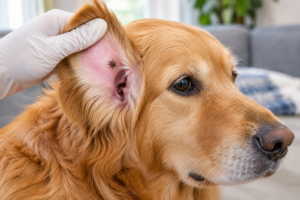
The key is knowing where the tick is attached: one on the visible outer ear may be removable at home with the right tools, while a tick inside the ear canal requires veterinary attention. This guide explains how to identify an ear tick, remove an accessible tick safely, recognize warning signs, and protect your dog from future infestations.
To remove an accessible tick, wear gloves, use fine-tipped tweezers or an appropriate tick-removal tool, grasp the tick close to the skin, and pull steadily without twisting or crushing it. Avoid applying oil, petroleum jelly, nail polish, or heat. These methods can irritate the tick and delay proper removal.
This guide explains how to recognize an ear tick, remove one safely when appropriate, know when to call a veterinarian, and reduce the chances of another infestation.
Can You Remove a Tick From Your Dog’s Ear at Home?
It depends on where the tick is attached. The outer ear flap, also called the pinna, is different from the ear canal, which leads toward the eardrum. The location of the tick and your dog’s behavior should determine your next step.
When careful home removal may be appropriate
You may be able to remove a tick at home if it is attached to the outer surface of the ear, is clearly visible, can be reached without inserting a tool into the canal, and your dog remains still enough for you to work safely.
When a veterinarian should remove the tick
Contact your veterinarian if the tick is deep inside the ear, close to the ear opening where access is difficult, embedded in a painful or swollen area, or impossible to grasp without pulling surrounding tissue. Seek professional help if your dog is struggling, snapping, or moving its head suddenly.
The ear contains delicate structures. Blindly inserting tweezers, cotton swabs, or other instruments can cause injury. Ear-canal ticks may also cause significant irritation and require examination with an otoscope.
How to Identify a Tick on Your Dog’s Ear
Ticks are small external parasites that attach to an animal’s skin and feed on blood. Depending on the species and feeding stage, a tick may look like a tiny, flat, dark speck or a rounded, swollen bump.
Ticks can attach to the outside of the ear, the skin on the ear flap, the base of the ear, or areas around the ear opening. Some species, including the spinose ear tick, have a particular association with the ears of their hosts.
Signs your dog may have a tick in or around the ear
- A small brown, black, gray, or reddish-brown object attached to the skin.
- A raised bump that remains attached when the surrounding fur moves.
- Repeated scratching around the ear.
- Frequent head shaking or rubbing the head against furniture.
- Redness, swelling, scabs, or irritation near the attachment site.
- Discomfort when you gently touch the ear.
These signs do not prove that a tick is present. Ear infections, mites, foreign objects, and other skin conditions can cause similar symptoms. If you cannot clearly identify what you see, have a veterinarian examine the ear rather than attempting to remove an unknown growth.
How to Remove a Tick From the Outer Ear Safely
Only attempt the following procedure when the tick is clearly visible and accessible on the outer ear. Do not use these instructions to remove a tick deep inside the ear canal.
What you will need
- Fine-tipped tweezers or a suitable tick-removal tool.
- Disposable gloves, if available.
- Good lighting and a clear view of the attachment site.
- A small sealed container for the removed tick.
- Soap and water for handwashing.
Step 1: Keep your dog calm
Choose a quiet place with good lighting. Ask another adult to gently hold and reassure your dog if necessary. Do not force your dog to remain still if it is distressed or painful. Sudden movement near the ear can cause injury.
Step 2: Examine the tick’s location
Gently lift the ear flap and inspect the visible skin. Determine whether the tick is on the outer ear or has moved into the canal. If you cannot see the entire attachment site clearly, stop and contact your veterinarian.
Step 3: Position the tweezers correctly
Using clean, fine-tipped tweezers, grasp the tick as close to the skin as possible, near its mouthparts. Avoid pinching the swollen body. Crushing the tick can expose you to its contents and may complicate removal.
Step 4: Pull slowly and steadily
Pull outward with steady, even pressure. Do not jerk, twist, or squeeze the tick. The aim is to remove it cleanly without breaking its mouthparts or injuring your dog’s ear.
If the tick will not come free with gentle traction, stop rather than digging into the skin. A veterinarian can remove a firmly attached tick with appropriate equipment.
Step 5: Clean the area and your hands
After removal, gently clean the small attachment site using a pet-appropriate approach recommended by your veterinarian. Do not pour alcohol, peroxide, essential oils, or other products into the ear canal. Wash your hands thoroughly and clean the removal tool according to its instructions.
Step 6: Dispose of the tick safely
Place the tick in a sealed container or use another safe disposal method recommended by your local health authority. Do not crush it with your bare fingers. If your veterinarian wants to identify the tick, ask how it should be stored and transported.
What Should You Do if a Tick Is Inside Your Dog’s Ear Canal?
Do not insert tweezers, cotton swabs, fingers, or other objects into the ear canal to search for or remove the tick. Arrange a veterinary examination promptly.
A veterinarian can examine the canal with an otoscope, determine the tick’s position, and select an appropriate removal method. Depending on the dog’s discomfort and the tick’s location, restraint or sedation may sometimes be necessary.
Seek urgent veterinary care if your dog has severe pain, bleeding, marked swelling, loss of balance, a head tilt, or sudden difficulty walking. These signs may indicate a problem that requires immediate assessment.
What If Part of the Tick Remains in the Skin?
Sometimes the tick’s mouthparts break off during removal. These are not the same as a complete tick remaining embedded under the skin.
If a tiny fragment remains and cannot be removed easily with clean tweezers, do not dig into your dog’s ear or skin. Further probing can cause additional injury. Ask your veterinarian whether the area needs examination or treatment.
Monitor the site for worsening redness, swelling, discharge, or persistent pain. Contact your veterinarian if these develop or if you are unsure whether the tick was removed successfully.
What You Should Never Do When Removing a Tick
Several common home remedies can make tick removal less safe or delay proper care.
- Do not burn the tick. Matches, lighters, or heated objects can burn your dog’s delicate ear tissue.
- Do not smother the tick. Petroleum jelly, oils, and nail polish are not recommended removal methods.
- Do not squeeze the tick’s body. Use a precise grip near the skin instead.
- Do not dig into the skin. Leave difficult mouthpart fragments for veterinary guidance.
- Do not pour household chemicals into the ear. Alcohol, peroxide, essential oils, and other substances can irritate or injure ear tissue.
- Do not use human medicines or unapproved pesticides. Tick-prevention products must be appropriate for the animal and used according to their labels.
Can Ticks in a Dog’s Ears Cause Health Problems?
Yes. An attached tick can irritate and damage the skin. Ear infestations may cause substantial discomfort, and some ticks can transmit disease-causing organisms. Certain species may also produce toxins associated with more serious effects.
Finding a tick does not mean your dog will necessarily develop a tick-borne disease. The risk depends on factors such as tick species, location, exposure, and how long the tick has been attached. Prompt removal is important, but it cannot guarantee that disease transmission has not occurred.
Symptoms to monitor after a tick bite
Watch your dog for changes in behavior and general health, including:
- Unusual tiredness or weakness.
- Reduced appetite.
- Fever or signs of discomfort.
- New or persistent lameness.
- Worsening redness, swelling, or discharge at the bite site.
- Continued head shaking, ear scratching, or sensitivity around the ear.
Contact your veterinarian if these signs appear. Seek urgent care for collapse, severe weakness, breathing difficulty, loss of coordination, or other sudden, serious symptoms. Tell the veterinarian about the tick exposure and when you discovered it.
How to Prevent Ticks From Attaching to Your Dog’s Ears
Removing a tick addresses the immediate problem. A prevention plan helps reduce future bites and infestations.
Check your dog’s ears every day
After outdoor activity, inspect both ear flaps, the bases of the ears, and the surrounding fur. Also check around the eyes, under the collar, beneath the front legs, between the toes, and around the tail. Do not insert anything into the ear canal during a routine check.
Use veterinarian-recommended tick prevention
Ask your veterinarian to recommend an appropriate tick-control product based on your dog’s age, weight, health, lifestyle, and local tick risks. Products may include oral treatments, topical products, or collars. Follow the label and dosing schedule exactly.
No product should be assumed to eliminate every tick immediately or provide complete protection against every tick-borne disease. Continue checking your dog even when using preventive treatment.
Reduce exposure around your home
- Keep grass trimmed and remove accumulated leaf litter and brush where practical.
- Limit access to heavily tick-infested vegetation.
- Keep your dog’s bedding and resting areas clean.
- Inspect other household pets after outdoor activity.
- Seek professional pest-control advice if ticks establish themselves indoors.
The Companion Animal Parasite Council recommends year-round tick control for dogs. Your veterinarian can help adapt prevention to your region and your dog’s individual risk.
Frequently Asked Questions
1. Can I remove a tick from my dog’s ear with tweezers?
Yes, if the tick is clearly visible and accessible on the outer ear. Use fine-tipped tweezers, grasp near the skin, and pull steadily without twisting. If the tick is in the ear canal, seek veterinary assistance.
2. What if the tick is deep inside my dog’s ear?
Do not attempt blind removal. A veterinarian can inspect the canal and remove the tick using suitable equipment while reducing the risk of injury.
3. Should I use oil or alcohol to make the tick let go?
No. Do not apply oil, petroleum jelly, nail polish, or heat to make a tick detach. Use a proper removal tool for an accessible tick, and keep chemicals out of the ear canal.
4. What happens if a tick’s mouthparts remain in my dog’s ear?
A small fragment may cause local irritation. Do not dig into the skin to remove it. If it cannot be lifted easily, or if redness, swelling, or pain develops, consult your veterinarian.
5. Can ticks live inside a dog’s ear?
Some tick species can attach in or around the ear canal. Ear infestations can be difficult to see and may cause significant irritation, so a suspected canal infestation should be examined by a veterinarian.
6. Does finding a tick mean my dog has a disease?
No. A tick bite does not automatically mean infection has occurred. Nevertheless, monitor your dog for illness and contact your veterinarian if symptoms appear or if you are concerned about local tick-borne diseases.
7. How often should I check my dog for ticks?
Check your dog daily, especially after outdoor activity. Pay particular attention to the ears, face, neck, underarms, paws, and other sheltered areas.
8. Can flea and tick prevention stop ear ticks?
Appropriate preventive products can reduce tick infestations, but effectiveness depends on the product and tick species. Ask your veterinarian which product is suitable for your dog, and continue regular inspections.
9. When should I take my dog to a veterinarian after finding a tick?
Seek veterinary help if the tick is inside the canal, cannot be removed safely, or is associated with pain, swelling, bleeding, or discharge. Sudden weakness, loss of balance, collapse, or other severe symptoms warrant urgent care.
Conclusion
Removing ticks from a dog’s ears requires care because the ear is sensitive and an attached tick can be difficult to grasp. If a tick is clearly accessible on the outer ear, use fine-tipped tweezers or an appropriate removal tool and pull steadily without twisting. If it is inside the ear canal, difficult to reach, or painful to remove, let a veterinarian handle it.
After removal, monitor your dog, check the rest of its body for ticks, and discuss an appropriate prevention plan with your veterinarian. Prompt removal, routine inspections, and suitable tick control can help protect your dog and your household.
Further Reading List
Recent Content
If you find a tick on your dog’s eyelid, remove it as soon as you can do so safely. A tick attached near the eye should be removed with clean, fine-tipped tweezers by grasping it...
What Kills Ticks on Dogs Instantly? What Works and What to Avoid
Discovering a tick attached to your dog can be worrying, especially when you want to remove it before it causes harm. The important thing to know is that no tick treatment should be assumed...