Teaching a dog recall means teaching them to return to you when you call. A reliable recall makes everyday life easier and can help you move your dog away from a hazard, end a play session safely, or regain control if a gate is left open. The goal is not simply for your dog to hear the word “come”; it is for them to learn that returning to you is worthwhile, even when something else is interesting.
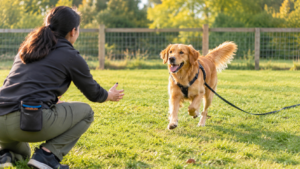
How to Teach a Dog Recall: A Step-by-Step Guide to Coming When Called.
Key Takeaways
- Start indoors or in a secure, quiet area before practicing outside.
- Use one consistent cue, such as “Come!” or “Here!”
- Reward the return with something your dog values: small treats, a favorite toy, play, or praise.
- Increase only one challenge at a time: distance, distraction, or location.
- Use a well-managed long line attached to a suitable harness while practicing outdoors.
- Never punish a dog for eventually coming back. Keep the cue positive.
What Is Recall Training?
Recall is the trained behavior of returning to a handler in response to a cue. It is useful for puppies and adult dogs alike, but it develops through repetition rather than a single lesson. Dogs may respond well in the living room and struggle at a park because smells, wildlife, other dogs, movement, and noise compete for their attention. That does not necessarily mean the dog is being stubborn; the setting may simply be too difficult for the current stage of training.
For this guide, the target audience is dog owners in the United States. Local leash laws and park rules vary, so check the rules for your city, county, and chosen recreation area before allowing a dog off leash.
What You Need Before You Start
- A clear recall cue: Choose one short word and use it consistently. Avoid repeating it over and over.
- Reward options: Use tiny, easy-to-eat treats, a toy, tug, or a brief game. Try a more valuable reward when distractions increase.
- A marker: Say “Yes!” at the moment your dog begins or completes the desired response, then deliver the reward. A clicker is optional.
- A regular leash and a secure harness: Use equipment that fits comfortably and allows you to manage your dog without yanking.
- A long line for outdoor practice: A 15–30-foot line can offer room to practice while keeping a safety connection. Start shorter if the area is cramped or the line is hard to manage.
Do not wrap a long line around your hand or let it run at speed through your fingers. It can cause rope burns, entanglement, or falls. Keep distance from roads, cyclists, other dogs, and people; use a helper if you need one.
How to Teach a Dog Recall: Step by Step
Step 1: Build a positive association with your cue
Start in a quiet room with your dog only a few feet away. Say their name to gain attention, then say your recall cue once in a friendly voice. Take a step backward, crouch slightly, or open your arms to encourage movement toward you. When your dog comes close, mark the behavior with “Yes!” and give a treat or play reward immediately.
Repeat a handful of times, then stop while your dog is still engaged. Short sessions are often easier for dogs than long, repetitive drills. If your dog does not respond, move closer, reduce distractions, and make the exercise easier rather than saying the cue louder and louder.
Step 2: Reward the arrival, not just the first step
When your dog reaches you, reward them near your body. You can gently touch their collar or harness for a moment, reward, then release them to continue playing. This teaches that approaching you and being safely handled are part of the routine. Keep handling gentle and avoid grabbing suddenly.
Practice calling your dog from a short distance, then gradually move farther away. Change rooms and practice with family members once your dog is successful in the first location.
Step 3: Make coming back part of a game
Try a simple “follow me” game: drop a treat a short distance away, let your dog eat it, then call them as you move backward. Reward when they reach you. If two people are available, take turns calling the dog between you from a short distance, rewarding every successful arrival.
Another option is to call your dog, reward them, and then release them with a consistent word such as “Go play.” This prevents recall from predicting that every bit of fun ends immediately.
Step 4: Add a little distance
Once your dog responds promptly at close range, practice across a room, down a hallway, or across a secure yard. Increase distance in small steps. If the dog hesitates several times, shorten the distance and rebuild success. Avoid moving from a quiet room directly to a busy dog park.
Step 5: Practice with mild distractions
Introduce one manageable distraction at a time: a family member sitting nearby, a toy on the floor, or a familiar outdoor area with little activity. Call when you have a reasonable chance of success. Reward generously, then let the dog return to the activity if it is safe.
As skills improve, practice around more challenging distractions at a distance. For example, start far enough from another dog that your dog can still eat a treat and respond to their name. If they are staring, pulling, barking, or unable to disengage, increase distance and make the exercise easier.
Step 6: Move outdoors using a long line
Begin in a securely fenced area or a quiet open space where leashes are allowed. Attach the long line to a well-fitted harness, allow your dog to explore, and call them at moments when they are likely to respond. When they return, reward, briefly touch the harness, and release them to sniff again.
The long line is a safety backup, not a tool for dragging the dog toward you. If your dog does not respond, move closer while calmly managing the line, regain their attention, and try an easier repetition. Never let a line trail near traffic or where it can snag on equipment, trees, or other dogs.
Step 7: Practice in different places
Dogs do not automatically generalize a skill to every environment. Repeat the same basic exercise in several safe locations, starting at an easier level in each new place. Train at different times of day and with different low-level distractions, but change only one major variable at a time.
Step 8: Build an emergency recall separately
Some owners teach a special emergency cue or whistle that predicts an unusually valuable reward. Choose a cue you do not use casually. In a quiet place, say or blow the cue and immediately give several small treats or a favorite reward. Repeat over short sessions until the cue has a strong positive association, then carefully practice in controlled situations.
An emergency cue is not a substitute for a leash, fencing, identification, or good judgment. Do not test it first when your dog is chasing wildlife or running toward a road.
A Simple Daily Recall Plan
| Stage | Practice | Move forward when… |
|---|---|---|
| Days 1–3 | Short sessions indoors, a few feet away, with valuable rewards. | Your dog turns and approaches happily in most easy repetitions. |
| Days 4–7 | Change rooms, add a little distance, and practice gentle collar or harness touches. | Your dog responds in more than one familiar place. |
| Week 2 and beyond | Use a long line in a quiet outdoor area; reward and release back to sniffing. | Your dog succeeds repeatedly despite mild distractions. |
| Ongoing | Practice around gradually harder distractions and revisit easier steps when needed. | Progress remains steady across different safe environments. |
This is a flexible example, not a deadline. Some dogs need more practice at each stage. Progress by performance, not by the calendar.
Common Recall Mistakes to Avoid
- Repeating the cue: Saying “come, come, come” while the dog ignores you can teach them that the word is background noise. Say it once when you have a reasonable chance of success.
- Calling only when fun ends: If every recall means leaving the park, the dog may avoid returning. Practice recalls during walks and release the dog back to safe activities.
- Punishing a late return: Scolding after the dog finally comes can make them less willing to return next time. Reward the return, then adjust the training setup.
- Increasing difficulty too quickly: A dog that succeeds indoors may not be ready for wildlife, crowds, or other dogs. Make the next step easier.
- Chasing the dog: Chasing may turn the situation into a game or push the dog farther away. If safe, move away from the dog, crouch, and encourage them toward you.
- Showing the treat before every cue: Food can be a useful reward, but the aim is to teach the cue itself. Practice sometimes with the reward concealed and deliver it after the response.
- Letting the dog off leash too soon: A good response at home does not prove reliability in public. Continue using a leash or long line until the dog is consistently successful and the area is legally and physically safe.
What If Your Dog Will Not Come When Called?
Your dog ignores you outside
Return to a quieter location, shorten the distance, and use a better reward. Practice at a distance from distractions where your dog can still pay attention. Do not keep repeating the cue in a situation that is currently beyond their skill level.
Your dog runs away when you approach
Avoid turning the interaction into a chase. Try moving away in an inviting way, rewarding any voluntary movement toward you, and practicing gentle harness or collar touches during easy sessions. Keep the dog on a long line in suitable areas while you rebuild the behavior.
Your dog comes close but will not let you clip the leash
Teach the leash routine separately: touch the harness, reward; clip the leash, reward; then release the dog again when safe. Practice when you are not in a hurry to leave. Do not make every approach predict restraint or the end of an enjoyable activity.
Your dog suddenly stops responding
Consider whether the setting has become harder, the cue has been repeated too often, or the reward is no longer motivating. If the change is sudden or your dog seems unable to hear, move normally, or engage, consult a veterinarian to rule out a health issue.
Pros and Cons of Reward-Based Recall Training
Pros
- Builds a positive association with returning to the handler.
- Can be practiced in short sessions at home.
- Rewards can be adapted to the individual dog.
- Supports cooperation with leash clipping and handling.
- Uses gradual practice rather than intimidation.
Cons and limitations
- Requires consistency and repeated practice.
- Progress may be slow around powerful distractions.
- Rewards and environments need to be adjusted to the dog.
- No recall is perfectly reliable in every emergency.
- Long lines require careful handling to avoid tangles or injury.
The American Veterinary Society of Animal Behavior recommends reward-based methods for dog training and advises against aversion methods. For dogs with intense fear, aggression, or persistent runaway behavior, seek help from a qualified, reward-based trainer or a veterinary behavior professional.
Five Useful Amazon Products for Recall Training
Equipment can make practice more convenient, but no product teaches recall by itself. Check current product listings, sizing, materials, availability, and reviews before buying. The links below open Amazon searches for the named product or category; they are not claims of independent product testing.
1. Mighty Paw 30-Foot Training Leash
Best for: Outdoor recall practice with extra distance while maintaining a physical safety connection.
Pros: Provides more room than a standard leash; useful for gradual distance work.
Cons: Needs space and careful handling; can snag or tangle in busy areas.
2. PetSafe Clik-R Training Clicker
Best for: Marking the exact moment your dog turns or arrives.
Pros: Gives a consistent marker sound; small and easy to carry.
Cons: Optional rather than essential; some dogs may initially find the sound startling, so introduce it gently.
3. Ruffwear Treat Trader Training Pouch
Best for: Keeping rewards accessible during walks and practice.
Pros: Helps deliver a reward promptly; useful for hands-on leash sessions.
Cons: Adds an item to carry; check fit, closure, and capacity for your routine.
4. Coachi Whizzclick Recall Whistle and Clicker
Best for: Owners who want to build a distinct whistle cue and use a marker sound.
Pros: Combines two training functions; a whistle can provide a consistent cue when trained properly.
Cons: The dog must learn what the sound means; it is not an instant recall solution.
5. Zuke’s Mini Naturals Training Treats
Best for: Small, quick rewards during repeated recall exercises.
Pros: Small treat format can help keep sessions moving; convenient for treat pouches.
Cons: Individual dogs may have dietary sensitivities or preferences; account for treats in the daily diet and check the current label.
Top Selection: A 15–30-Foot Training Long Line
For most owners beginning outdoor recall practice, a suitable long line is the most practical first purchase because it creates room to practice while helping prevent the dog from running off. Attach it to a well-fitted harness, use it only where there is enough open space, and learn to manage the line safely. If your dog is powerful or the line is difficult to control, ask a qualified trainer to help you choose equipment.
Frequently Asked Questions
How long does it take to teach a dog recall?
There is no fixed timeline. Some dogs learn the first steps quickly but need months of practice to respond around difficult distractions. Advance according to consistent success, not a promised number of days.
What is the best word to use for recall?
Choose a short, clear cue such as “come” or “here.” Consistency matters more than the specific word. If the old cue has become associated with repeated calls or frustration, a new cue may help when introduced from the beginning.
Should I give my dog a treat every time they come?
Use frequent, worthwhile rewards while teaching the skill, especially in new or distracting settings. Once recall is well established, vary the reward thoughtfully, but keep returning rewarding through treats, play, praise, or access to safe activities.
Can an older dog learn recall?
Yes. Adult and older dogs can learn new behaviors. Start with short, easy sessions and consider physical comfort, hearing, vision, and previous learning history. Ask a veterinarian about sudden changes in responsiveness.
Should I let my dog off leash if they usually come when called?
Only where it is legal and physically safe, and after the dog has demonstrated consistent responses in similar conditions. Use fenced spaces when possible. Near roads, wildlife hazards, or crowded areas, keep the dog leashed even if recall is usually strong.
What should I do if my dog ignores the recall cue?
Do not repeat the cue endlessly or punish the dog. Move closer if safe, use an inviting body posture, reduce distractions, and practice an easier repetition. Review whether the reward is valuable enough for the environment.
Is a whistle better than calling my dog’s name?
A whistle can provide a consistent sound over distance, but it still needs to be conditioned with rewards and practiced in stages. It is a tool, not a replacement for training or safety management.
Can I use a shock or prong collar to improve recall?
The American Veterinary Society of Animal Behavior recommends reward-based training and advises against aversion methods, including electronic collars and prong collars. If recall is difficult, reduce the challenge and seek a qualified professional who uses humane, reward-based methods.
Conclusion
To teach a dog recall, begin in a quiet space, choose one cue, and reward every successful return. Build distance gradually, add distractions carefully, and practice outdoors with a well-managed long line. Make coming back a positive experience rather than a signal that punishment or the end of fun is coming.
Keep your dog leashed around roads and other hazards, follow local leash rules, and remember that training is ongoing. If your dog’s behavior changes suddenly or recall remains difficult despite careful practice, consult a veterinarian or a qualified reward-based trainer.
You may also like: How to Remove Ticks From Dogs Safely: A Step-by-Step Guide
More resources for Dog Training.
- American Veterinary Society of Animal Behavior (AVSAB): Position Statements and Humane Dog Training
- UC Davis School of Veterinary Medicine: Recall Training in Dogs (PDF)
- American Kennel Club: How to Train Your Dog to Come When Called
- Battersea Dogs & Cats Home: How to Teach Your Dog a Recall
- RSPCA Knowledgebase: How Can I Teach My Dog Recall?
Recent Content
Ticks can attach to almost any part of your dog's body, but some locations are much easier to overlook than others. The ears, eyelids, collar area, armpits, paws, groin, and tail deserve particular...
How to Check Your Dog’s Paws for Ticks: A Step-by-Step Guide
Your dog may return from a walk looking perfectly clean, but a tiny tick could be hiding between the toes, beside a paw pad, or underneath a patch of fur. Because these areas are easy to overlook,...