Ticks do not appear fully grown. They develop through four stages—egg, larva, nymph, and adult—and most hard ticks must feed on blood during each active stage before they can develop further. Understanding this life cycle helps dog owners recognize tiny ticks, understand why an infestation can return, and choose prevention measures that address ticks before and after they reach a dog.
Tick Life Cycle Explained: Larvae, Nymphs, and Adult Ticks.
The key point is that tick control is not only about removing large, visible adults. Larvae and nymphs can also feed on animals, and their small size makes them easy to miss. Depending on the species, ticks may feed on wildlife, dogs, people, or several different hosts as they mature. Some species, including the brown dog tick, can establish infestations around homes and kennels.
- Ticks have four life stages: egg, six-legged larva, eight-legged nymph, and eight-legged adult.
- Eggs do not feed on blood; larvae, nymphs, and adults do.
- Many hard ticks leave their host after feeding and molt in the environment.
- Tick development may take months or years, depending on species and environmental conditions.
- Use a veterinarian-recommended preventive, inspect your dog regularly, and manage tick-friendly areas around your home.
Useful first step: Ask your veterinarian which tick preventive suits your dog’s age, weight, health, lifestyle, and region. A tool for removing ticks helps with an existing attachment, but prevention is needed to reduce future exposure.
Interactive-looking overview: The four stages of the tick life cycle
THE TICK LIFE CYCLE
Simplified stages — timing and hosts vary by species
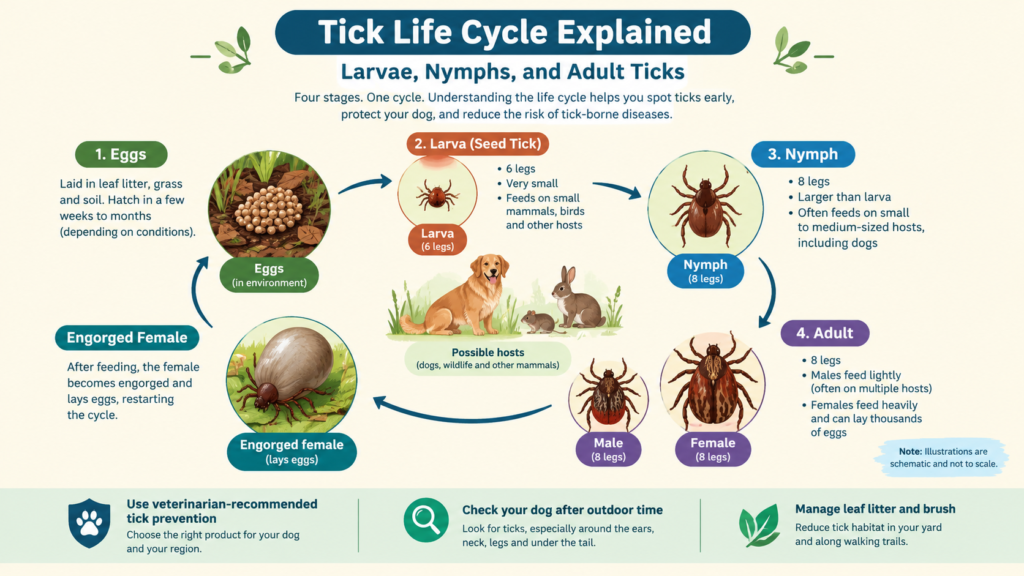
1. Eggs
Laid in the environment
2. Larva
Six legs; needs blood
3. Nymph
Eight legs; needs blood
4. Adult
Eight legs; feeds and mates
Fed female
Drops off and lays eggs
Prevention insight
Interrupt feeding and
reproduction where possible
Illustrations are schematic and not to scale. Not every tick species follows identical timing or host patterns.
Important: The diagram shows the general pattern for many hard ticks. Some species have different host preferences and developmental schedules. For example, brown dog ticks can complete their life cycle around dogs and in sheltered environments, while many other hard ticks use different hosts during different stages.
What Are the Four Stages of a Tick?
1. Egg stage: Where a new generation begins
After feeding and mating, a female hard tick generally detaches from its host and lays eggs in a protected location in the environment. Depending on the species, that location may be leaf litter, soil, cracks, kennel areas, or other sheltered places. The female typically dies after laying her eggs.
Eggs do not bite dogs or feed on blood. They are the starting point of the next generation, and they are often too small to notice individually. A large egg mass can eventually produce many larvae, although many newly hatched ticks never find a suitable host and do not survive to adulthood.
2. Larval stage: Tiny six-legged “seed ticks”
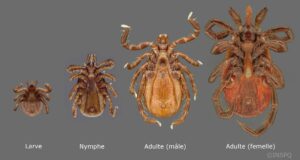
When tick eggs hatch, the larvae have six legs. They are often called seed ticks because their small size can make them look like specks or tiny seeds. Larvae are usually much harder to spot than engorged adult ticks.
Larvae must find a host and take a blood meal to develop to the next stage. For many hard-tick species, the host may be a small mammal, bird, reptile, or another suitable animal. After feeding, the larva commonly drops off and molts into a nymph in the environment.
Finding many tiny ticks close together can be a sign that a dog has entered an area where larvae hatched or gathered. However, appearance alone cannot reliably establish the species or the source.
Can tick larvae bite dogs?
Yes. Larvae of many tick species can attach to and feed on suitable hosts, including dogs when the species’ host preferences allow it. Their small size means that a larval tick can be missed during a quick visual check.
Larvae are not simply harmless baby ticks. Their disease risk varies with tick species and pathogen. Some pathogens can be passed from an infected female tick to her eggs, while other pathogens are acquired during a blood meal and carried through later developmental stages.
3. Nymph stage: Small, eight-legged ticks
After a larva feeds and molts, it becomes a nymph. Nymphs have eight legs, like adults, but they are generally smaller and have not yet reached the reproductive adult stage.
Nymphs must also find a host and feed. Depending on the tick species, that host may be a small or medium-sized mammal, a bird, or a larger animal. Some nymphs can attach to dogs or people and may go unnoticed because they are small.
After feeding, a nymph of many hard-tick species drops off its host and molts into an adult. The timing depends on species, temperature, humidity, and other environmental conditions.
4. Adult stage: Feeding, mating, and reproduction
Adult ticks have eight legs. They search for a suitable host, attach, and feed. In many hard-tick species, males and females may mate on the host or, in some species, away from it. After feeding and mating, an adult female generally detaches and lays eggs in the environment.
Female hard ticks can become much larger after feeding because their bodies expand as they take in blood. A heavily engorged tick may therefore look very different from a flat, unfed tick. Adult males usually do not expand in the same way because their hard dorsal shield covers more of the body.
Adult ticks are often easier to notice than larvae and nymphs, but the size and appearance of a tick depend on its species, sex, and feeding status. Never assume that a tick is safe simply because it is small or appears flat.
How Long Does the Tick Life Cycle Take?
There is no single timeline that applies to every tick. Some species can complete their life cycle in a matter of months under suitable conditions, while others may take two or three years, or longer in certain climates and at higher elevations.
| Stage | What happens | What owners should know |
|---|---|---|
| Egg | A female lays eggs in a protected environment. | Eggs do not feed on dogs, but may lead to a new generation of larvae. |
| Larva | A six-legged tick finds a host and takes a blood meal. | Very small larvae may be difficult to see in fur. |
| Nymph | An eight-legged immature tick feeds, then molts. | Nymphs can be missed during a quick inspection. |
| Adult | Adults feed and mate; a female may later lay eggs. | Removing visible adults is useful but does not address every life stage. |
Temperature, humidity, host availability, and tick species all affect development. Some ticks survive for extended periods without feeding when conditions permit. A yard or building can therefore continue to pose a risk even when no tick is visible at a particular moment.
Do All Ticks Follow the Same Life Cycle?
No. The four stages are a useful general model, but tick species differ in how many hosts they use, where they lay eggs, how long development takes, and which animals they prefer.
Three-host ticks
Many hard ticks that affect dogs in North America are described as three-host ticks. In a typical pattern, the larva feeds on one host, the nymph feeds on a host after molting, and the adult feeds on another host. The hosts do not always have to be different species or different individual animals.
Between blood meals, the tick commonly drops off the host and develops in the environment. This is one reason ticks may be picked up in several places during a dog’s normal activities.
Brown dog ticks: An important exception for households
The brown dog tick is particularly relevant to dog owners because it can maintain infestations in homes, kennels, and other sheltered environments. Different stages may feed on dogs, and ticks can hide in cracks, crevices, bedding areas, or kennel structures.
Repeatedly finding ticks indoors deserves attention. Simply removing ticks from the dog may not be enough if ticks are also established in the surrounding environment. A veterinarian can help with pet treatment, while a qualified pest-control professional may be needed to assess a building infestation.
For broader prevention guidance, read PetGrommer’s Best Flea and Tick Prevention for Dogs.
How Ticks Find Dogs
Ticks do not usually jump or fly. Many wait on vegetation or remain in areas where suitable hosts pass. This behavior is often called questing: a tick positions itself where it can contact a passing animal and uses its front legs to grasp the host.
Dogs may encounter ticks while walking through tall grass, brush, woodland edges, leaf litter, or other areas where ticks and their hosts are present. Wildlife and other animals can contribute to tick populations around a property.
Ticks may attach to different body areas after reaching a dog. A careful inspection should include the ears, neck, collar line, legs, paws, groin, armpits, belly, and tail area. If your dog has a tick in a sensitive location, follow the specific safety guidance in How to Remove Ticks From a Dog’s Ears or Tick on a Dog’s Eyelid.
Why Tick Life Stages Matter for Disease Prevention
Ticks can transmit pathogens to animals and people, but the risk depends on the tick species, the pathogen involved, the region, and the circumstances of exposure. Not every tick carries a pathogen, and not every bite results in illness.
Some pathogens are acquired by ticks when they feed on an infected animal during an earlier life stage. The tick may carry the pathogen through molting and transmit it during a later feeding. Other pathogens can pass from an infected female tick to her eggs. These are examples of different transmission pathways within the tick life cycle.
Because larvae, nymphs, and adults may all take blood meals, prevention should not focus only on large adult ticks. It is also important to recognize signs of illness after a tick exposure.
Do not wait for symptoms to become severe, and tell the veterinarian when you found the tick if you know.
How to Interrupt the Tick Life Cycle
No single household action can guarantee that ticks will disappear. A practical plan combines veterinary-recommended prevention, routine checks, safe removal, and sensible environmental management.
1. Use a preventive selected for your dog
Veterinary-recommended tick preventives include oral treatments, topical products, and medicated collars. Their active ingredients, approved tick species, duration, and safety instructions differ. Choose a product based on your dog’s age, weight, health history, lifestyle, and the tick risks in your region.
Follow the label exactly. Never use a product on a cat just because it is intended for dogs, and do not combine treatments or give an extra dose without veterinary guidance. Some ingredients used in dog products can be dangerous to cats.
2. Inspect your dog after outdoor activities
Check the entire coat after walks, garden play, hikes, and visits to places where ticks may live. Use bright lighting, part the fur, and feel gently for small bumps. Pay attention to areas that are easy to overlook, including between the toes and beneath the collar.
3. Remove attached ticks promptly and safely
Use fine-tipped tweezers or a suitable tick-removal device, following the tool’s instructions. With tweezers, grasp the tick as close to the skin as possible and pull steadily. Avoid squeezing the body, burning the tick, applying nail polish or petroleum jelly, or digging into the skin to retrieve mouthparts.
For a step-by-step walkthrough, visit How to Remove Ticks From Dogs Safely.
4. Reduce tick-friendly habitat around the home
Where appropriate, keep grass maintained, remove accumulated leaf litter, manage dense brush, and keep pet resting areas clean. Prevent dogs from entering places with heavy tick activity when practical.
If ticks repeatedly appear indoors, do not assume that yard maintenance alone will solve the problem. A brown dog tick infestation may require a coordinated plan involving veterinary treatment of pets and professional environmental control.
5. Keep a simple tick-check routine
Record when you find ticks, where your dog was, whether the tick appeared attached, and which preventive product your dog uses. If ticks keep appearing, this record can help your veterinarian assess whether exposure is unusually high or the prevention plan needs review.
Five Different Products to Consider for Tick Monitoring and Care
The following items are intended to support inspection, safe handling, or environmental monitoring. They are not substitutes for veterinary treatment, and they do not all kill or repel ticks. Product links lead to Amazon search results so you can compare current listings before purchasing.
1. Tick drag cloth for checking outdoor areas
A tick drag cloth is a sampling tool used to check vegetation for ticks. It can help an adult who understands the technique investigate whether ticks may be present in an area, but it does not prove that a yard is tick-free.
Potential advantages
- Useful for monitoring vegetation in suitable outdoor areas.
- Can help identify places where additional caution may be warranted.
- Does not involve applying a chemical to your dog.
Limitations
- Sampling results depend on the method, weather, location, and tick activity.
- It does not prevent ticks from reaching or attaching to a dog.
- Children should not handle collected ticks unsupervised.
2. Tick identification card with magnifier
A magnifying identification card can make it easier to examine a small tick and compare its appearance with reputable identification references. It may help you take a clearer photograph or record visible details for your veterinarian.
Potential advantages
- Portable and easy to store with pet-care supplies.
- Magnification can help when examining a very small specimen.
- May support documentation of tick size and visible markings.
Limitations
- A consumer card cannot guarantee species identification.
- Appearance changes with life stage and feeding status.
- Do not delay removing an attached tick while trying to identify it.
3. Small specimen collection vials
If a veterinarian asks you to retain a tick for possible identification, a secure specimen vial may help contain it during transport. Ask the clinic how it wants the tick stored; requirements may vary depending on the purpose of identification or testing.
Potential advantages
- Helps keep a specimen contained rather than loose in a bag.
- Can be labelled with the date and location where the tick was found.
- Useful for organizing a specimen when a clinic has requested one.
Limitations
- Not every removed tick needs to be submitted for testing.
- Do not assume a tick test predicts whether your dog will become ill.
- Keep specimens away from children and pets.
4. Disposable nitrile examination gloves
Disposable gloves can be useful when handling a tick or cleaning the area after removal. They do not replace handwashing, correct tick-removal technique, or safe disposal.
Potential advantages
- Provide a disposable barrier during handling.
- Useful for keeping a basic pet-care kit organized.
- Can also be used for other routine pet-care tasks when appropriate.
Limitations
- Gloves can tear and do not make it safe to crush a tick.
- They must be removed and discarded correctly.
- Wash hands after use even if gloves were worn.
5. Compact LED inspection flashlight
A small LED flashlight can help illuminate dark areas of a dog’s coat during a tick check, especially around the ears, collar line, feet, and belly. Choose one that is easy to hold while gently parting the fur.
Potential advantages
- Improves visibility during close inspection.
- Portable for walks and travel.
- Useful for examining dark-coated dogs in dim rooms.
Limitations
- Light alone cannot reveal every tick beneath thick fur.
- Do not shine a bright light directly into your dog’s eyes.
- It does not prevent ticks or replace a suitable preventive.
Common Mistakes to Avoid
- Looking only for large ticks: Larvae and nymphs can be much smaller and easier to miss.
- Assuming one tick means only one tick: Check the whole dog after finding an attachment.
- Believing grooming alone prevents ticks: Grooming helps with inspection but does not replace a preventive.
- Applying an extra dose after finding a tick: Ask your veterinarian before changing a treatment schedule.
- Ignoring recurring indoor ticks: An established brown dog tick infestation may need professional environmental control.
- Using products intended for another species: Always check the label and use the product only as directed.
- Assuming every tick bite causes disease—or that no symptoms means no risk: Risk varies, so seek veterinary advice if your dog becomes unwell.
Frequently Asked Questions
How many stages does a tick have?
Most ticks have four stages: egg, larva, nymph, and adult. The larva has six legs, while the nymph and adult have eight. The egg stage does not feed on blood; the active stages do.
Can tick larvae live on dogs?
Larvae of many tick species can attach to suitable hosts and take a blood meal. Whether they commonly feed on dogs depends on the tick species and local host patterns. Their small size makes them easy to overlook.
Are nymph ticks dangerous to dogs?
Nymphs can bite dogs and may transmit pathogens, depending on the species and whether the tick is infected. A nymph is not harmless simply because it is immature or small.
How long does it take for a tick to become an adult?
The timing varies by species and environment. Some ticks can complete development in months under favorable conditions; others take two or more years. Temperature, humidity, and access to suitable hosts affect the schedule.
Do ticks die after laying eggs?
Female hard ticks generally die after laying their eggs, but life-history details vary among tick groups. The eggs can hatch into larvae and begin another generation if conditions allow.
Can ticks reproduce inside a house?
Yes. Some species, especially the brown dog tick, can establish infestations in buildings and kennels. Repeated indoor findings should prompt a coordinated plan involving veterinary advice and, when necessary, professional pest control.
Does removing adult ticks stop the life cycle?
Removing attached ticks helps protect the individual dog, but it may not remove eggs or unattached ticks from the environment. Prevention, regular checks, and environmental management are more comprehensive than removal alone.
Should dogs receive tick prevention all year?
Veterinary parasite organizations commonly recommend year-round tick control for dogs, but the most suitable plan depends on the dog and regional risks. Ask your veterinarian which product and schedule are appropriate where you live.
Can I identify the tick species from a phone photo?
A clear photo may help with preliminary identification, but it may not show the details needed to distinguish similar species or life stages. Do not delay safe removal while taking pictures. Ask your veterinarian or a qualified identification service if knowing the species matters.
Conclusion: Understand the Life Cycle to Improve Tick Prevention
The tick life cycle begins with eggs and continues through larva, nymph, and adult. The active stages need blood meals, and many hard ticks leave their hosts to molt before seeking another meal. This means that tiny immature ticks, visible adults, and ticks in the surrounding environment can all be relevant to a dog’s exposure.
For practical protection, combine regular tick checks with safe removal, a veterinarian-recommended preventive, and sensible management of the places where your dog rests and plays. If ticks keep appearing indoors or your dog develops signs of illness after exposure, seek professional help rather than relying on accessories alone.
Read more
- Centers for Disease Control and Prevention (CDC): Tick Lifecycles
- CDC DPDx: Ticks
- Companion Animal Parasite Council: Ticks
- Merck Veterinary Manual: Overview of Ticks
- VCA Animal Hospitals: Ticks in Dogs
- Ticks Infesting Dogs and Cats in North America: Biology, Geographic Distribution, and Pathogen Transmission
Recent Content
The American dog tick (Dermacentor variabilis) is a blood-feeding parasite found widely across the eastern United States and in limited areas west of the Rocky Mountains. Adults typically...
Lone Star Ticks on Dogs: How to Identify, Remove, and Prevent Them.
Lone star ticks on dogs can be difficult to spot, especially when they attach around the ears, neck, face, or other areas covered by fur. These blood-feeding parasites can irritate your dog's skin,...