How Big Are Ticks? A Dog Owner’s Guide to Tick Sizes.
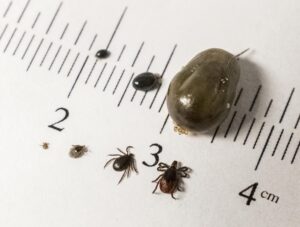
In general, tick larvae and nymphs may measure around 1 millimeter or less, depending on the species. Many unfed adult ticks measure approximately 3–5 millimeters, while some engorged adult females can reach roughly 8–13 millimeters or more. These measurements are useful comparisons, not universal dimensions for every tick species. Public-health guidance on tick identification and veterinary references describe substantial differences between stages and species.
Key Takeaways: How Big Are Ticks?
- Larvae: Usually tiny, often less than 1 millimeter.
- Nymphs: Commonly around 1 millimeter, although size varies by species.
- Unfed adults: Often approximately 3–5 millimeters.
- Engorged adult females: May grow to around 8–13 millimeters or more, depending on the species and feeding stage.
- Important: A tiny tick can still be medically significant. Do not ignore a suspected tick because it looks small.
Recommended first step: Use a bright, well-directed light for close inspection and discuss a suitable tick preventive with your veterinarian. An inspection accessory can help you see the coat, but it cannot prevent tick bites by itself.
Tick Size Chart: From Tiny Larvae to Engorged Adults
The table below provides a practical size comparison. Tick dimensions differ among species, so use these ranges as general guidance rather than a definitive identification chart.
| Tick stage | Approximate size | What it may look like |
|---|---|---|
| Larva | Often under 1 mm | A tiny speck; six legs |
| Nymph | Often around 1 mm | Similar to a small seed; eight legs |
| Unfed adult | Commonly about 3–5 mm | A small, flat, oval-shaped parasite |
| Engorged adult female | May reach 8–13 mm or more | A swollen, rounded or bean-like body |
Remember: These measurements are not a reliable way to identify a tick species on their own. Some species are naturally smaller or larger than others, and feeding changes a tick’s shape considerably. See the Merck Veterinary Manual guide to ticks of dogs for additional veterinary information.
Visual Guide: How Tick Sizes Compare
A size-comparison illustration can make the differences between tick stages easier to understand.
How to read a tick-size comparison
- Look at the scale: A millimeter is one-thousandth of a meter. Ten millimeters equal one centimeter.
- Compare the body: An engorged tick’s body expands after feeding; the rigid dorsal shield of a hard tick does not expand in the same way.
- Do not judge by appearance alone: Color, body shape and leg visibility can vary.
1. How Small Are Tick Larvae?
Tick larvae are among the smallest active tick stages. They hatch from eggs and typically have six legs, unlike nymphs and adults, which have eight. Their tiny size can make them difficult to distinguish from ordinary debris, small skin particles or other insects.
Larvae need a blood meal to develop to the next stage. Depending on the tick species and local conditions, they may feed on small mammals, birds or other available hosts. Some tick species can also infest dogs during immature stages.
Why larvae are difficult to find on dogs
- Their bodies may be smaller than a millimeter.
- Their legs can be hard to see without magnification and good lighting.
- Dark or dense fur can conceal them.
- Several tiny ticks may be present together, making an infestation look like a cluster of specks.
If you notice numerous tiny moving specks or many attached parasites, do not assume they are harmless because of their size. Arrange veterinary advice, particularly if your dog has skin irritation, weakness or other signs of illness.
2. How Big Are Tick Nymphs?
Nymphs are the developmental stage between larvae and adults. They usually have eight legs and can be around 1 millimeter in size, although dimensions vary among species.
Some nymphs are often compared with a poppy seed. This is a useful visual analogy, but it is not a precise measurement: seeds vary in size, and different tick species have different dimensions.
Why a tiny nymph still matters
Nymphs can be easy to overlook during routine grooming. Depending on the species and the pathogens present in your area, immature ticks can transmit infections. Size alone cannot tell you whether a tick is carrying a pathogen.
Inspect your dog carefully after outdoor exposure, and seek veterinary advice if you find an attached tick or notice signs of illness.
Where should you look for small ticks?
Part the fur gently and examine the skin in good light. Pay particular attention to:
- Around the ears and the skin folds around them.
- Under the collar and around the neck.
- Under the front legs and around the armpits.
- Between the toes and around the feet.
- Around the groin, tail and beneath the tail.
- Along the belly and other areas with thinner fur.
For more detail, read PetGrommer’s guide to removing ticks from dogs safely. It explains how to inspect the attachment point and when professional help is appropriate.
3. How Big Are Adult Ticks?
Unfed adult hard ticks commonly measure around 3–5 millimeters, although the range depends on the species and sex. Some may be smaller or larger. They often appear flat or oval before feeding.
Adult ticks generally have eight legs. Their color can range from reddish-brown or dark brown to grayish or patterned, depending on the species. A tick’s appearance is affected by lighting, its position in the coat and how much it has fed.
Why adult ticks may be easier to notice
- They are often larger than larvae and nymphs.
- Their bodies may be more visible when the fur is parted.
- Some species have distinctive markings, although those markings may be difficult to see without magnification.
However, an adult tick can still be missed on a dog with a thick coat. Do not limit your inspection to large, obvious bumps. Feel gently through the fur, then examine suspicious spots directly.
4. How Big Can an Engorged Tick Get?
An engorged tick is one that has fed on blood. As feeding continues, the body of many ticks expands, becoming rounder and more prominent. An engorged adult female of some species may reach approximately 8–13 millimeters, and some ticks may grow beyond that range.
A heavily fed tick may resemble a small bean, swollen seed or grayish oval bump. Its appearance depends on species and how far feeding has progressed.
A swollen tick needs attention
A larger tick may have been feeding for some time, but size cannot establish exactly how long it has been attached or whether it has transmitted an infection.
Remove an accessible attached tick promptly using an appropriate method. Do not burn it, crush it with bare fingers, or coat it with petroleum jelly or nail polish. If it is difficult to remove or is attached in a sensitive area, contact your veterinarian.
Why does an engorged tick become so much larger?
During feeding, a tick takes in blood and its body expands. In many hard ticks, the female’s rigid dorsal shield remains relatively unchanged while the softer body behind it expands. This is why a fed female can look very different from an unfed one.
The Companion Animal Parasite Council notes that female hard ticks can increase substantially in weight during feeding. The exact size change depends on the tick species and its feeding stage. See the CAPC tick guidelines for veterinary parasite-control context.
5. What Everyday Objects Can Help You Imagine Tick Size?
Everyday comparisons can help readers picture tick dimensions, but they should not be treated as exact measuring tools.
- Larvae: May be comparable to a very tiny speck.
- Nymphs: Some are roughly comparable to a poppy seed.
- Unfed adults: May resemble a small oval seed.
- Engorged adult females: Can resemble a small bean or swollen seed.
These comparisons are only approximate. A suspected tick may look different because of its species, feeding status, angle, lighting or the surrounding fur. Use a reliable image reference or ask a veterinarian if identification matters.
6. How to Tell a Tick From a Skin Tag or Other Bump
Not every lump on a dog’s skin is a tick. Skin tags, warts, cysts, scabs, inflamed follicles and other skin growths can resemble attached parasites.
Signs that may suggest a tick
- A distinct body attached at one point to the skin.
- Small legs visible close to the attachment point.
- A flat or oval body that appears to sit on the skin.
- A body that is rounded or swollen after feeding.
Signs that may suggest a skin growth
- The bump appears to be part of the dog’s skin rather than a separate body.
- No legs or distinct parasite body can be seen.
- The bump has been present for a long time or changes gradually.
These clues are not definitive. If you cannot identify the bump, avoid pulling or cutting it. Take a clear photograph and ask your veterinarian to examine it. A photograph may help with discussion, but it cannot always confirm an identification.
7. How to Check Your Dog for Tiny Ticks
Regular inspection is useful because ticks may be difficult to notice, particularly during the immature stages. Make a tick check part of your routine after walks, outdoor play, visits to kennels or time in areas where ticks may be present.
Step 1: Choose good lighting
Inspect your dog in a well-lit area. A bright lamp or headlamp can help illuminate the coat while keeping both hands free. Avoid shining intense light directly into your dog’s eyes.
Step 2: Part the fur
Separate the coat in small sections so that you can see the skin. Work methodically rather than checking only the back or the most visible areas.
Step 3: Inspect the common hiding places
Check the ears, neck, under the collar, armpits, feet, between the toes, groin, belly and tail area. Be gentle around the eyes and ear canal; do not insert tools into these sensitive areas.
Step 4: Look and feel
Run your fingers gently over the coat to find unusual bumps, then separate the fur to examine anything suspicious. A tick may feel like a small bump before you can see it clearly.
Step 5: Remove or get help
For an accessible attached tick, use fine-tipped tweezers or a suitable tick-removal device according to reliable instructions. Grasp close to the skin and pull steadily with tweezers. Do not squeeze the tick’s swollen body.
If the tick is in the ear canal, close to the eye, difficult to reach, or your dog is distressed, seek veterinary help. A dog with a heavy infestation should also be assessed by a veterinarian.
Read the full step-by-step guide to safe tick removal before attempting removal if you are unsure of the technique.
8. Useful Products for Inspecting Your Dog’s Coat
Inspection accessories can make it easier to examine a dog’s fur, but none of these products should be presented as a treatment or a substitute for tick prevention. The following are accessory categories to compare when building a grooming and inspection kit.
Product 1: Lighted magnifying glass
A hand-held magnifier with built-in lighting may help you examine a suspicious speck after parting the fur. It is particularly useful for checking details that are difficult to see with the naked eye.
Pros
- Can make small details easier to inspect.
- May be useful for examining a removed specimen.
- Compact models are easy to store.
Cons
- Magnification does not confirm tick species.
- Some models have poor lighting or a narrow viewing area.
- It can be difficult to use on a moving dog.
Product 2: Hands-free LED headlamp
A comfortable headlamp can illuminate the dog’s coat while you use both hands to separate fur. Choose one with adjustable brightness and a stable fit.
Pros
- Keeps hands free during inspection.
- Useful for checking dark coats and poorly lit areas.
- Can also help with general pet care and outdoor activities.
Cons
- Bright beams may startle some dogs if directed at their faces.
- Battery life and comfort vary between models.
- Lighting alone cannot reveal every tick hidden beneath thick fur.
Product 3: Grooming gloves
Grooming gloves can help you feel along the coat and remove loose hair during routine grooming. They are not designed to remove attached ticks, but they may help make a coat inspection part of a familiar grooming session.
Pros
- May be comfortable for dogs that dislike some brushes.
- Useful for loose hair and everyday coat care.
- Can help owners slow down and inspect the coat section by section.
Cons
- Do not reliably detect or remove every tick.
- May be less effective on some dense or tangled coats.
- Must not be used to squeeze or rub an attached tick.
Product 4: Adjustable grooming table arm and restraint
For owners who already groom their dogs on a suitable grooming table, a compatible restraint system may help keep the dog comfortably positioned during routine coat checks. It is not necessary for every household and should never be used to force a distressed dog to remain still.
Pros
- Can help position a dog for coat inspection during supervised grooming.
- May be useful for owners who already have a compatible grooming table.
- Can make some routine grooming tasks more organized.
Cons
- Requires correct installation and continuous supervision.
- May be unsuitable for anxious, injured or uncooperative dogs.
- Must never be used in a way that risks choking, falling or injury.
Product 5: Washable, light-colored grooming mat
A light-colored mat can provide a clean, visible surface for routine grooming and may make loose hairs or detached debris easier to notice. It will not reliably catch or identify ticks, and it should not be treated as a tick-control product.
Pros
- Provides a defined surface for routine grooming.
- Light colors may make some loose debris easier to see.
- Washable designs can be convenient for repeated use.
Cons
- Does not prevent ticks from attaching to a dog.
- Loose ticks may still crawl away from the mat.
- Some materials may slide on smooth floors or be difficult to clean.
Our practical recommendation: If you are starting from scratch, prioritize good lighting and a calm, repeatable inspection routine. A lighted magnifier or headlamp may help you examine suspicious areas, but proper tick removal and a veterinarian-recommended preventive are more important than buying multiple grooming accessories.
9. How to Prevent Ticks From Becoming a Bigger Problem
Understanding tick size helps with detection, but size awareness alone cannot prevent an infestation. Combine regular checks with a suitable prevention plan.
Use an appropriate tick preventive
Ask your veterinarian which preventive is suitable for your dog’s age, weight, health history, lifestyle and local parasite risks. Products differ in their ingredients, duration, approved uses and safety instructions. Follow the current product label and never combine treatments without veterinary guidance.
For a broader comparison, read PetGrommer’s guide to flea and tick prevention for dogs. Use it as a starting point for questions to discuss with your veterinarian, not as a replacement for individualized advice.
Check your dog after outdoor activity
Inspect your dog after walks, play in vegetation, travel and time in places where ticks may occur. Depending on the region, tick exposure may happen during more than one season of the year.
Keep coat care consistent
Regular brushing and grooming can make it easier to inspect the skin, especially on dogs with long or dense coats. Grooming alone is not a reliable tick preventive, and ticks may still attach even when a dog is well groomed.
Manage the dog’s surroundings
Keep outdoor areas maintained where practical, remove accumulated leaf litter and brush near frequently used spaces, and clean pet bedding according to its care instructions. If you repeatedly find ticks indoors, seek veterinary and qualified pest-control advice to identify the source and choose appropriate control measures.
10. When Should You Contact a Veterinarian?
Contact a veterinarian if your dog has a heavy tick infestation, a tick lodged in the ear canal or near the eye, or a tick that you cannot safely remove. Veterinary advice is also important if the bite area becomes increasingly swollen or painful.
After tick exposure, watch for changes such as unusual tiredness, loss of appetite, fever, weakness, pale gums, unexplained bleeding, limping or difficulty walking. These signs can have several causes, but a recent tick exposure is important information for your veterinarian.
Seek urgent veterinary care for severe symptoms
Difficulty breathing, collapse, sudden paralysis or rapidly worsening weakness requires urgent veterinary assessment. Do not wait for a tick to become larger before seeking help.
Frequently Asked Questions About Tick Size
How big is the smallest tick?
Some tick larvae are less than 1 millimeter long. Exact dimensions vary by species, and very small ticks can be difficult to see without good lighting or magnification.
Are ticks smaller than poppy seeds?
Some larvae and nymphs can be as small as, or smaller than, a poppy seed. The comparison is approximate because both tick and seed sizes vary.
How big is an adult tick on a dog?
Many unfed adult ticks measure around 3–5 millimeters, but size differs among species and sexes. Some adult ticks may be outside this range.
How big does an engorged tick get?
An engorged adult female of some species may reach approximately 8–13 millimeters or more. Its size depends on the species and how far feeding has progressed.
Can a tiny tick make my dog sick?
Yes. A tick’s small size does not mean it is harmless. Some immature ticks can transmit pathogens, depending on the species and the region. If your dog becomes unwell after tick exposure, contact a veterinarian.
How can I tell if a small bump is a tick?
Look for a distinct parasite body and, when visible, legs near the attachment point. A skin tag or other growth may look similar. If you are uncertain, do not cut or pull at the bump; ask a veterinarian to examine it.
Can ticks be too small to see?
They can be very difficult to see, particularly larvae and nymphs hidden beneath fur. Good lighting, careful parting of the coat and a consistent inspection routine can improve your chances of finding them, but no inspection method detects every tick.
Does a bigger tick mean it has been attached longer?
A tick that has fed may become larger, but size alone cannot establish exactly how long it has been attached. Species and feeding status affect size, so do not use appearance to calculate a precise attachment time or disease risk.
Should I remove a tick that is very small?
If you are confident it is an attached tick, remove it promptly using an appropriate method. If it is difficult to access, is close to the eye or inside the ear, or your dog will not stay still, ask a veterinarian for help.
Can grooming prevent ticks?
Grooming can help you inspect your dog’s coat, but it does not reliably prevent tick bites or remove every attached tick. Combine regular checks with a veterinarian-recommended preventive and appropriate environmental management.
Conclusion: Small Ticks Deserve Attention
Ticks range from tiny larvae and nymphs to larger adults and swollen, engorged females. Larvae may be under 1 millimeter, nymphs may be around 1 millimeter, unfed adults often measure about 3–5 millimeters, and some engorged adult females can reach roughly 8–13 millimeters or more.
The most important lesson is that size alone cannot identify a tick species, determine how long it has been attached, or establish whether it can transmit disease. Inspect your dog carefully, remove accessible ticks promptly and safely, and seek veterinary help when a tick is difficult to remove or your dog shows signs of illness.
For ongoing protection, pair routine tick checks with a preventive chosen for your dog and the parasites found in your area. A consistent routine is more useful than relying on the size of a tick to decide whether it matters.
Recent Content
Ticks do not appear fully grown. They develop through four stages—egg, larva, nymph, and adult—and most hard ticks must feed on blood during each active stage before they...
The American dog tick (Dermacentor variabilis) is a blood-feeding parasite found widely across the eastern United States and in limited areas west of the Rocky Mountains. Adults typically...