Your dog may return from a walk looking perfectly clean, but a tiny tick could be hiding between the toes, beside a paw pad, or underneath a patch of fur. Because these areas are easy to overlook, checking your dog’s paws should be part of your regular post-walk routine.
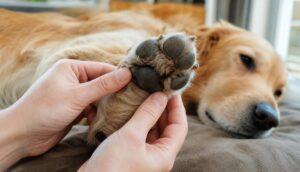
How to Check for Ticks on Your Dog’s Paws: A Step-by-Step Guide.
In this guide, you will learn how to inspect your dog’s paws, recognize a possible tick, remove one safely, and establish a practical tick-checking routine. You will also discover useful tools that can make tick checks easier.
Key Takeaways
- Check all four paws, including the spaces between every toe and the skin around the paw pads.
- Use good lighting and gently separate the fur to inspect the skin.
- Look for small, attached bumps, dark or reddish-brown bodies, and localized irritation.
- Remove an attached tick promptly using fine-tipped tweezers or an appropriate tick-removal tool.
- Never burn a tick or try to suffocate it with petroleum jelly, oil, nail polish, or other substances.
- Contact your veterinarian if you cannot remove the tick safely, the paw becomes inflamed, or your dog develops concerning symptoms.
Why You Should Check Your Dog’s Paws for Ticks
Ticks do not only attach around a dog’s ears, neck, or belly. They can also be found on the feet, between the toes, and around the paw pads. A dog may pick them up while walking through grass, brush, leaf litter, woodland trails, or other areas where ticks are present.
When a tick attaches to the skin, it can be difficult to notice, especially if your dog has thick fur, dark skin, or heavily pigmented paw pads. Small ticks may resemble tiny specks or bumps until you look closely.
1. The paws come into contact with outdoor environments
Your dog’s feet regularly brush against grass, vegetation, soil, and leaf litter. A tick can move from the environment onto the fur or skin and eventually attach to a suitable location.
Checking the paws after walks is particularly useful when your dog has been exploring long grass, wooded paths, overgrown gardens, or areas where ticks are known to occur.
2. The spaces between the toes are easy to overlook
Many owners examine the tops of their dogs’ feet but forget to spread the toes. Ticks can attach in the narrow spaces between the digits, where fur, skin folds, and limited visibility make inspection more difficult.
Do not stop after looking at the visible surface of each paw. Gently separate the toes and inspect the skin on both sides of each space.
3. Ticks may be hidden near the paw pads
Examine the edges of the large central paw pad, the smaller digital pads beneath the toes, and the skin surrounding them. Pay attention to any new bump or attached object that was not there previously.
Remember that paw irritation is not automatically evidence of a tick. Cuts, splinters, allergies, foreign objects, and other skin conditions can produce similar signs.
4. Early detection helps you respond sooner
Ticks can transmit pathogens while feeding, and the likelihood of transmission varies with the tick species and the pathogen involved. Prompt removal is recommended rather than waiting to see whether the tick falls off.
Regular inspection also helps you notice redness, swelling, broken skin, or persistent licking that might need veterinary attention.
What Do Ticks Look Like on a Dog’s Paws?
A tick may appear as a small, rounded or oval bump attached firmly to the skin. Its color can range from brown or reddish-brown to gray or nearly black, depending on the species and whether it has fed.
An unfed tick may be extremely small. As it feeds, its body can enlarge, making it more noticeable.
Ticks have eight legs as adults and nymphs, although their legs may be difficult to see without close inspection. A tick attached to the skin generally does not jump like a flea.
Signs that an object may be an attached tick
- A small, rounded body attached directly to the skin.
- A bump that remains in the same place when the surrounding fur is moved.
- Tiny legs visible near the front of the body when viewed closely.
- Localized redness, swelling, or irritation around the attachment site.
- A bump that gradually becomes larger as the tick feeds.
Tick or something else?
Not every lump on a dog’s paw is a tick. A wart, scab, skin growth, small cyst, splinter, or other foreign object can look similar. Do not pull at a suspicious lump simply because you think it is a parasite.
If you cannot confidently identify the object, or if the area is painful, swollen, or bleeding, ask your veterinarian to examine it.
How to Check for Ticks on Your Dog’s Paws: 7 Steps
Allow a few quiet minutes for the examination. Choose a well-lit place where your dog can sit or lie comfortably. If your dog is nervous about having their feet handled, take breaks and reward calm behavior rather than forcing the inspection.
Step 1: Prepare your dog and gather your supplies
Before you begin, gather:
- A bright flashlight or another reliable light source.
- A clean towel or light-colored surface to help you see anything that falls from the fur.
- A pair of fine-tipped tweezers or a suitable tick-removal tool.
- Disposable gloves, if available.
- Soap and water for handwashing.
Keep your dog comfortable and gently lift one paw at a time. Avoid pulling the legs into an awkward position or pressing hard on the toes.
Step 2: Examine the top of each paw
Begin with the upper surface of the paw. Gently move the fur aside and inspect the skin, especially around the base of the toes and the edges of the foot.
Look for unusual bumps, attached dark specks, or areas of redness. Use your fingers to feel gently through the fur, but do not squeeze suspicious lumps.
Repeat this process on both front paws and both back paws. Do not assume that checking one foot means the others are clear.
Step 3: Check between every toe
This is one of the most important steps. Using your thumb and fingers, gently separate the toes so that you can see the skin between them.
Inspect each space from the upper side of the paw toward the area nearer the pads. Move the fur aside carefully and use your light to illuminate any shaded areas.
- Look for small bumps attached to the skin.
- Check both sides of each toe.
- Inspect the folds where the toes meet the paw.
- Look for redness, swelling, or a spot your dog repeatedly licks.
Work methodically rather than rushing. A small tick can be missed when the toes are not fully separated.
Step 4: Inspect the paw pads and their edges
Gently turn the paw enough to see the underside. Examine the large central pad and the smaller pads beneath the toes.
Pay particular attention to the skin around the edges of each pad, where fur and skin meet. Check for a suspicious attached bump, redness, or swelling.
Do not dig into the pads or scrape the skin in an attempt to find a tick. If you suspect that an object is embedded deeply or the area hurts your dog, stop and contact your veterinarian.
Step 5: Check around the nails and dewclaws
Look around the base of each nail and the surrounding skin. If your dog has dewclaws, examine the skin around them as well.
These areas can be easy to miss during a quick visual check. Gently move the fur aside and look for any new bump or attached parasite.
A damaged nail, a broken claw, or an inflamed nail bed can also cause discomfort, so avoid assuming that every problem in this area is caused by ticks.
Step 6: Feel gently for unusual bumps
After the visual inspection, run your fingertips lightly over the skin and through the fur. This can help you notice small bumps that are difficult to see.
If you feel a bump, part the fur and inspect it before doing anything else. Do not use a comb, fingernail, or tweezers to scrape at it until you have a clearer idea of what it is.
If you cannot identify the bump or suspect that it may be attached to the skin, seek veterinary guidance.
Step 7: Repeat on all four paws and check the rest of the body
Finish the examination by checking all four feet again if necessary. Then inspect the rest of your dog, because ticks can attach to many different parts of the body.
Pay attention to the ears, around the eyes, under the collar, beneath the front legs, between the back legs, and around the tail. Run your hands gently through the coat to feel for unusual bumps.
The U.S. Centers for Disease Control and Prevention recommends checking pets daily, particularly after outdoor activity, and specifically identifies the spaces between the toes as an area to examine.
How Often Should You Check Your Dog’s Paws for Ticks?
Make paw checks part of your daily routine, especially if your dog spends time outdoors. It is useful to examine the paws immediately after a walk through vegetation or another area where ticks may be present.
| Situation | Recommended approach |
|---|---|
| After a walk in grass or brush | Inspect all four paws and then check the rest of the body. |
| After hiking or visiting wooded areas | Perform a thorough head-to-tail tick check, including the spaces between the toes. |
| After playing in the garden | Check the paws, particularly if the garden has tall grass or dense vegetation. |
| During a normal day | Include a quick paw inspection in your regular grooming routine. |
| When ticks are common in your area | Follow your veterinarian’s advice on daily checks and year-round prevention. |
Ticks may be active at different times of year depending on the species, weather, and location. Do not assume that your dog is protected simply because it is winter or because the weather has recently become cooler.
What to Do If You Find a Tick on Your Dog’s Paw
If you discover a tick attached to your dog’s paw, stay calm. Avoid squeezing it or trying to pull it off with your fingers. Prompt, careful removal is important, but you should not risk injuring your dog while attempting it.
Important tick-removal safety warning
Do not burn a tick, crush its body, or attempt to make it detach with petroleum jelly, oil, nail polish, or other household substances. These methods are not recommended and can delay effective removal or irritate the skin.
How to remove an attached tick safely
- Keep your dog still. Have another person gently help hold your dog if needed. Stop if your dog is struggling or the area is too painful to handle safely.
- Prepare your removal tool. Use clean, fine-tipped tweezers or a tick-removal device and follow the tool manufacturer’s instructions.
- Get close to the skin. With fine-tipped tweezers, grasp the tick as close to the skin as possible without pinching your dog’s skin.
- Remove it carefully. With tweezers, pull upward using steady, even pressure. Do not jerk or crush the tick. If you are using a specialized device, follow its specific instructions.
- Inspect the site. Check whether the tick appears intact and examine the skin for irritation or remaining material.
- Clean the area and your hands. Wash your hands and clean the bite site with soap and water or as directed by your veterinarian. Clean the tool according to its instructions.
- Dispose of the tick safely. Avoid crushing it with your fingers. Use a secure disposal method recommended by your local health authority or veterinarian.
The Merck Veterinary Manual, drawing on CDC guidance, recommends prompt removal with fine-tipped tweezers, grasping close to the skin and pulling steadily upward without twisting the tweezers.
Read the Merck Veterinary Manual’s tick-removal instructions.
What if part of the tick remains in the skin?
If the tick breaks during removal, do not dig into your dog’s paw with a needle, blade, or tweezers to retrieve material embedded in the skin. You may cause additional injury.
Contact your veterinarian for advice, especially if the area becomes painful, swollen, increasingly red, or starts to discharge fluid.
When should you ask a veterinarian to remove the tick?
Seek professional help if:
- Your dog will not tolerate handling of the paw.
- The tick is in a sensitive or difficult-to-reach location.
- You cannot remove it without squeezing or injuring the skin.
- The object may not be a tick.
- The paw is significantly swollen, painful, or bleeding.
- You are unsure whether the tick has been completely removed.
Because the paw is a small, sensitive area, it is better to ask for help than to force the procedure.
Five Tick-Removal Tools to Consider for Dog Owners
A suitable tick-removal tool can help you handle an attached tick more carefully. The options below are alternatives to the products previously recommended for this article series. They serve different purposes, and no tool guarantees complete removal in every situation.
How to choose a tool
- Look for a design that allows you to get close to the tick’s attachment point.
- Choose a tool you can control comfortably when handling a small paw.
- Follow the manufacturer’s instructions rather than assuming every tool works the same way.
- Remember that a veterinarian may be the safest option when the tick is difficult to reach or your dog is distressed.
1. ZenPet Tick Tornado Tick Removal Tool
The ZenPet Tick Tornado is a dedicated tick-removal device designed to help remove ticks without squeezing their bodies. It may be worth considering for dog owners who want a purpose-built tool in their pet first-aid supplies.
Potential benefit: A specialized removal design rather than an improvised household tool.
What to check: Confirm that the tool can be used appropriately on the size and location of the tick you find. Be particularly careful around the narrow spaces between toes.
2. TickEase Tick Removal Tweezer Tool
TickEase is a tick-removal product line associated with tools for removing ticks from people and pets. A tweezer-style tool can be useful when a tick is small and you need to grip it close to the skin.
Potential benefit: A familiar tweezer-style approach for careful, controlled removal.
What to check: Review the exact model’s instructions and confirm that the tips are appropriate for the task. Avoid pinching the surrounding skin.
3. HomeSake Tick Remover Tool and Tweezer Set
A tick-removal set may be convenient for owners who want more than one tool format available. Different shapes can be useful for different tick sizes or attachment locations, provided the selected tool is suitable for the job.
Potential benefit: Multiple tool styles in one set, depending on the exact listing.
What to check: Confirm the current product contents, construction, cleaning instructions, and suitability for pets. Do not assume all sets sold under similar names are identical.
4. The Original Tick Key
The Original Tick Key is a compact tick-removal device designed to fit into a small kit or pocket. Its portable format may appeal to owners who want to carry a removal tool during outdoor activities.
Potential benefit: Portability for walks, travel, and hiking kits.
What to check: Read the manufacturer’s directions carefully. A compact tool may not be the easiest option for every tiny tick or every difficult paw location.
5. O’Tom Tick Twister
The O’Tom Tick Twister is a tick-removal tool designed to help remove attached ticks. Its hook-style design differs from traditional tweezers, so owners should learn how to use the particular tool before attempting removal on a sensitive paw.
Potential benefit: An alternative to a tweezer-style remover.
What to check: Follow the product’s specific instructions. Do not substitute a twisting technique with ordinary tweezers if your veterinary guidance calls for steady upward pressure.
Our practical recommendation: Choose a tool you understand how to use correctly, and keep it clean and accessible. Fine-tipped tweezers are a widely recommended option. If you are uncertain about a tick attached between your dog’s toes, contact your veterinarian rather than experimenting with a tool.
Recommended Resource: Are Seed Ticks Dangerous to Dogs
How to Prevent Ticks From Attaching to Your Dog’s Paws
Regular inspection is important, but it is only one part of tick prevention. A prevention plan should consider your dog’s environment, local tick risks, health status, and the products recommended by your veterinarian.
1. Use veterinarian-recommended tick prevention
Ask your veterinarian which tick-prevention product is appropriate for your dog’s age, weight, health, lifestyle, and location. Options may include prescription or nonprescription products, depending on local availability and the particular product.
Follow the label exactly. Never combine tick treatments or use a product intended for another animal unless your veterinarian confirms that it is safe. Some ingredients used in dog products can be dangerous to cats and other animals.
2. Be cautious around long grass and dense vegetation
Where practical, keep your dog on maintained paths and avoid unnecessary contact with overgrown vegetation. This can reduce some opportunities for ticks to come into contact with your dog’s coat.
3. Make paw checks part of grooming
Inspect between the toes, around the nails, and near the pads whenever you clean or dry your dog’s feet. A consistent routine makes it easier to notice new bumps and skin changes.
4. Keep your outdoor environment maintained
Where ticks are a concern, maintaining lawns, reducing excessive vegetation near commonly used areas, and following local pest-management advice may help manage exposure. No yard-maintenance measure guarantees a tick-free environment.
5. Keep a record of tick encounters
Note when and where you find ticks, whether they were attached, and any subsequent changes in your dog’s behavior or health. This information can help your veterinarian assess exposure and advise you about prevention.
Signs That Your Dog’s Paw May Need Veterinary Attention
After finding and removing a tick, monitor the area and your dog. A small amount of local irritation may occur, but worsening symptoms should not be ignored.
Contact your veterinarian if you notice:
- Increasing redness, swelling, warmth, or pain at the bite site.
- Pus, discharge, or a wound that is not healing.
- Persistent licking, chewing, or sensitivity around the paw.
- Limping or reluctance to put weight on the foot.
- A persistent lump or an object you could not fully identify or remove.
Tick-borne diseases can also cause symptoms beyond the paw. Depending on the disease, signs may include lethargy, fever, reduced appetite, weakness, or lameness.
When to seek prompt veterinary care
If your dog develops marked weakness, difficulty breathing, collapse, severe pain, or another serious or rapidly worsening symptom, seek urgent veterinary care. If your dog becomes unwell after a tick bite, tell the veterinarian about the exposure and when it occurred.
Not every tick bite causes disease, and symptoms can vary. A normal-looking bite site does not rule out every possible tick-borne infection. Follow your veterinarian’s advice about monitoring and any testing that may be appropriate for your location and your dog’s exposure.
Have you tried Tick Repellents? Check: The Safest Tick Repellents for Dogs.
Frequently Asked Questions
1. Where do ticks hide on a dog’s paws?
Ticks may attach between the toes, around the edges of the paw pads, near the nails, and in fur-covered areas on the top of the feet. Inspect all four paws rather than checking only the visible underside.
2. Can ticks live between a dog’s toes?
Yes. Ticks can attach to the skin between a dog’s toes. These spaces are easy to overlook, so gently separate each toe and inspect the skin after outdoor activity.
3. What does a tick look like on a dog’s paw?
A tick often looks like a small, rounded or oval bump attached firmly to the skin. It may be brown, reddish-brown, gray, or black. Its size depends on the species and whether it has fed. Some other skin conditions can look similar, so seek veterinary advice if you are uncertain.
4. Can I remove a tick from my dog’s paw at home?
You may be able to remove an accessible tick with fine-tipped tweezers or an appropriate tick-removal tool if your dog stays calm and you can do so safely. If the tick is difficult to reach, the paw is painful, or your dog struggles, ask a veterinarian to remove it.
5. Should I twist or pull a tick off my dog?
Follow the instructions for the tool you are using. The CDC-based guidance in the Merck Veterinary Manual recommends gripping the tick close to the skin and pulling upward with steady, even pressure when using fine-tipped tweezers. Specialized tick-removal tools may have different instructions. Do not jerk, crush, or squeeze the tick.
6. What should I do if my dog keeps licking one paw?
Check the paw gently for a tick, injury, splinter, nail problem, or other visible irritation. Persistent licking can have several causes. Contact your veterinarian if the behavior continues, the paw is swollen or painful, or you cannot identify the problem.
7. How often should I check my dog’s paws for ticks?
Check them daily, especially after your dog has been outdoors. A thorough inspection is particularly useful after walks through grass, brush, woodland, or other tick-prone environments.
8. Can a tick transmit disease if it is attached to my dog’s paw?
Yes. The location of the bite does not eliminate the risk of tick-borne disease. Transmission depends on the tick and the pathogen involved. Remove attached ticks promptly and contact your veterinarian if your dog becomes unwell.
9. Should I use alcohol, oil, or petroleum jelly to make a tick release?
No. Do not apply alcohol, oil, petroleum jelly, nail polish, or heat to an attached tick to make it detach. Use an appropriate removal method and clean the area after removal.
10. Does tick prevention mean I no longer need to inspect my dog’s paws?
No. Preventive products can reduce risk, but no prevention strategy should replace regular checks. Follow your veterinarian’s prevention recommendations and continue inspecting your dog’s paws and body.
Recommendation: Make Paw Checks Part of Your Dog’s Routine
Checking your dog’s paws for ticks does not need to be complicated. With good lighting, gentle handling, and a consistent routine, you can inspect the top of each paw, separate the toes, examine the pads, and check around the nails.
If you find an attached tick, remove it promptly using an appropriate method or ask your veterinarian for help. Avoid home remedies that burn, crush, or attempt to suffocate the tick, and monitor your dog for signs of irritation or illness afterward.
Most importantly, combine regular paw checks with a veterinarian-recommended tick-prevention plan. A few careful minutes after an outdoor adventure can help you notice a problem early and respond appropriately.
More resources for Dog Owners.
Recent Content
Are seed ticks dangerous to dogs? Yes, they can be. A large number of ticks may cause intense irritation, skin damage, and, in severe infestations, blood loss. Depending on the tick...
How Flea Bites Trigger Allergies, Hair Loss and Hot Spots in Dogs
Flea bites can cause much more than a few itchy bumps. In dogs with flea allergy dermatitis (FAD), proteins in flea saliva trigger an allergic skin reaction that can lead to...